Chapter 2 · The Agentive World
Chapter 1 established the dividing question: if the human opens applications to do their work, the organization lives on the agentic side; if not, it has crossed to the Agentive side. This chapter assumes the answer is no — that the organization has crossed the Nadella Line — and develops, with the calm and detail the question deserves, what that crossing means in practice.
The question is not trivial. Any executive, architect, or consultant who has faced a large technological transition knows that the consequences of the crossing are never the deck of slides with optimistic arrows that the first evangelist promises. The real consequences are rugged, asymmetric, partly predictable and partly surprising. But there is a core of changes that can indeed be anticipated with discipline, and it is those changes that this chapter describes.
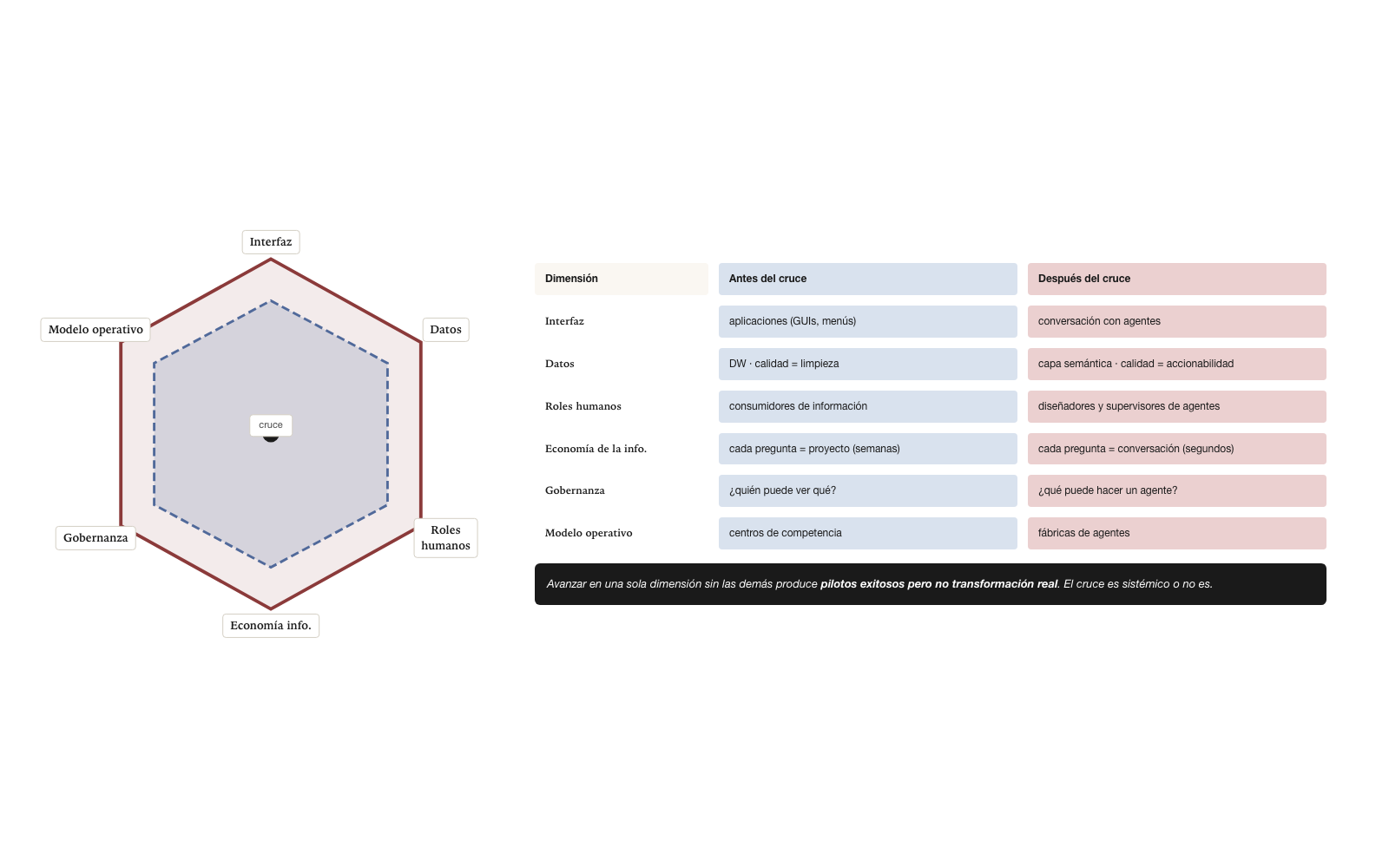
Crossing the Nadella Line simultaneously changes six dimensions of any organization’s operation: the way the human interacts with the system, the nature of the data the system consumes, the roles of human work, the economics of information, governance, and the operating model. None of the six changes in isolation. Advancing on one without the others produces successful pilots but no real transformation — an observation the consulting firms that have documented the field repeat with uncomfortable frequency. The crossing is systemic or it is not.
We will begin with the most visible consequence: the collapse of the application as the primary interface of cognitive work.
The collapse of the application as interface
For forty years enterprise software was built around an implicit postulate that was rarely made explicit: the minimal unit of interaction is the application. The human opens Excel to model numbers. Opens Salesforce to manage opportunities. Opens Power BI to review dashboards. Opens ServiceNow to open tickets. Opens Confluence to document. Each application has its screen, its menu, its mental model, its learning curve. The valuable skill of the modern knowledge worker consisted, in large part, of knowing how to operate a reasonable collection of applications well — knowing where each thing is, how to get there, which button to press.
That postulate ceases to operate in the Agentive World. The application, seen as the primary interface of work, collapses. But one must be precise about what exactly collapses, because the claim read without nuance can sound more radical than it is.
Not everything disappears. Distinguishing is important so as not to lose credibility before an executive who has to decide a budget. GUIs as the entry point to work die fast: the human stops opening Salesforce to review the pipeline and instead asks an agent which opportunities require attention. Applications as backend systems survive, but invisibly: the agent that answered about the pipeline queried Salesforce via API. Salesforce, as a system, is still there. As a human interface, it is not. Traditional office suites — Office, Google Workspace — reposition themselves: Word, Excel, and PowerPoint cease to be the first choice of the user who needs to write, calculate, or present — the agent does it. They survive in cases of fine editing, specific formatting, or creative work where conversation is inefficient relative to direct work. And specialized tools with a complex surface — CAD, Figma, advanced IDEs, music DAWs — survive longer: their interface encodes professional knowledge that conversation takes time to replace.
The emerging pattern is sharp. Applications that exist to navigate and filter information die fast under the pressure of the Agentive World. They were visual intermediaries between the human and the data, and an agent with direct access to the data makes the intermediary unnecessary. Those that exist to produce specialized artifacts survive longer, though eventually with a copilot or agent as mediator. The transition is not uniform across categories of application, and the stack leaders who plan it well accept that unevenness.
A useful image for intuitively grasping what happens: think of the Agentive World as the one in which enterprise applications live beneath a conversational layer, not on top of it. The human never sees them, but the agents query them continuously. Salesforce does not disappear: it becomes the database of customer relationships that a sales agent consumes without the human ever seeing its UI. Power BI does not disappear: it becomes an analytical-query endpoint that a financial agent invokes when asked about quarterly performance. ServiceNow does not disappear: it remains the ticket record that an operations agent consults and updates without opening the portal. Applications become invisible backend infrastructure. Their value survives as a structured store of data and business logic. They lose their value as interface.
Applications do not disappear. What disappears is the obligation for the human to open them.
The analytics industry — the oldest and most consolidated in enterprise software — was the first to openly accept that the “human opens application” model had hit its ceiling. Tellius frames it with the candor of an actor that has seen the cycle: “Dashboards still tell you what happened, but rarely why — and never what to do next.” Superwise extends the observation: “BI was built for a slower business environment — that assumption no longer holds true.” These are not marketing provocations — they are acknowledgments of a persistent operational problem that the BI industry has tried to solve for fifteen years with successive cosmetic redesigns, until it understood that the problem was not cosmetic but structural. The interface itself — the dashboard as a visual artifact the human must open, look at, and interpret — was the bottleneck.
The new economics of information
If I had to single out one change that crossing the Nadella Line produces on an organization’s daily operation, it would be this: the collapse of the marginal cost of an analytical question. It is the least visible of the six changes and, at the same time, the most transformative. It is the enabling condition of everything else this chapter describes.
In the traditional model, every new business question implies a project. The sequence is familiar and painful: the executive poses the question to their BI area; the BI area coordinates with the executive to pin down the scope; the analysts gather the relevant data; the developers build the report or dashboard; the validators confirm the result is correct; the executive receives the answer. The whole process typically takes between four and twelve weeks. The real bottleneck, as is often said in mature organizations, is not the technology — it is the transfer of knowledge between people. There are humans in the middle, and each human introduces latency and the possibility of an interpretation error.
The cost of putting the traditional model into operation is no trivial matter either: building the Data Lake → Synapse → Power BI chain, or any modern equivalent, demands a six-figure initial setup, sustained monthly operation, and months until the first useful dashboard (Chapter 7 develops the detailed BI cost figures). And all that investment delivers the capacity to answer only those questions someone foresaw when designing the system. The unanticipated questions — the ones the executive really wants to ask when they arrive on Monday with a new intuition — are not on the menu. They wait in the queue, or they are not asked.
When that cost collapses from weeks to seconds, the very nature of the relationship between the organization and its information changes. Three immediate effects transform daily operation.
The first is that analytical capacity becomes elastic. It adapts in real time to the current need, not to what someone pre-defined months ago. There is no fixed menu: there is unlimited responsiveness within the limits of the available data. The executive who has an intuition on Monday explores it on Monday — they do not wait until Thursday for the BI team to have the dashboard ready. The speed of analytical curiosity ceases to be limited by the infrastructure.
The second is that iteration replaces specification. In the traditional model, the executive had to specify in advance what they wanted to see, wait for the result, and from there formulate the next question. The latency of each cycle was weeks, so the questions had to be very well posed — the cost of a framing error was high. In the agentive model, the executive poses a first approximate question, receives the answer in seconds, refines, deepens, discards hypotheses, pursues others. Knowledge emerges from dialogue, not from the project. The very form of doing analysis changes: from sequential project to continuous conversation.
The third is perhaps the deepest: the questions that were never asked are now asked. When asking is free, the organization discovers insights it did not even know it needed. Analytical curiosity ceases to be limited by the BI budget. An executive who in the traditional model reserved their queries for the most obvious, highest-return questions — because each one cost the BI area a project — begins to also ask the marginal questions, the exotic hypotheses, the details that in the old model did not justify the cost. And they discover, frequently, that the marginal questions contained the most valuable insights.
This transformation is not merely a quantitative improvement. It is the enabling condition of everything else in this chapter. The continuous intelligence cycle we will describe in the next section cannot exist if each iteration takes weeks. The autonomy governance we will describe later makes no sense if the agents do not operate in real time. The transformation of human roles we will describe at the end does not occur if access to knowledge continues to depend on human intermediaries. The collapse of the cost of the question is not a feature of the agents — it is the precondition of everything else.
From the classic cycle to the continuous intelligence cycle
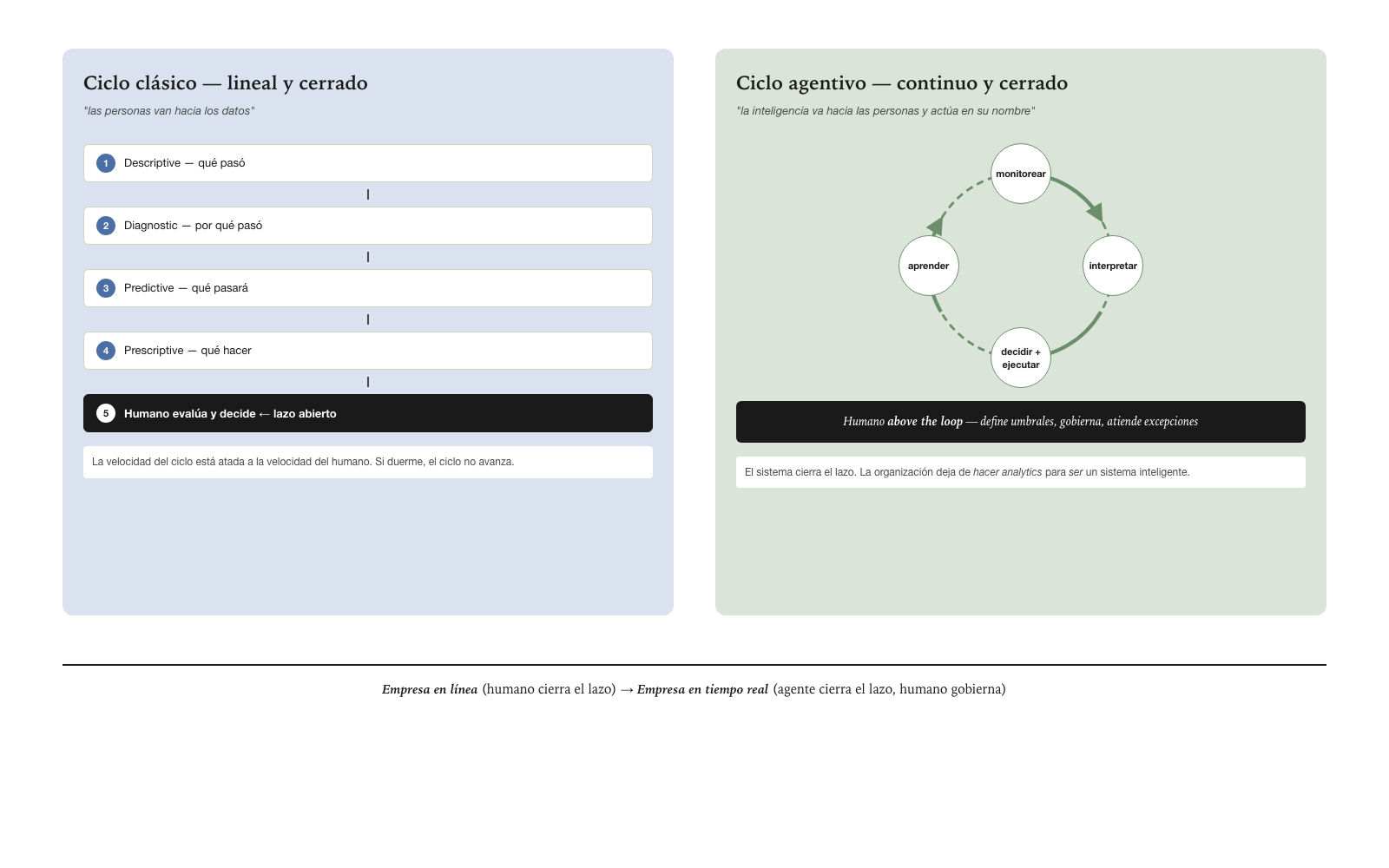
For thirty years the information-management paradigm rested on the principle “people go to the data”. The phrase sounds anodyne but it encodes the entire operating model of classic BI: you build a data warehouse, you set up dashboards, you train users, and you hope someone looks at the right report at the right moment and makes the right decision. The whole model rests on human attention as the scarce resource, the bottleneck around which the system is designed.
The classic cycle is linear: descriptive → diagnostic → predictive → prescriptive → human decides. It starts with data describing what happened, continues by diagnosing why it happened, predicts what will happen, prescribes what to do, and ends with a human evaluating the prescription and deciding. The human who decides is the end of the cycle — the last step, the close. And the speed of the cycle is tied to the speed of that human. If the human is busy, the cycle does not advance. If the human is on vacation, the cycle does not advance. If the human is asleep, the cycle does not advance.
Agentive AI inverts that flow. The canonical phrase of the new paradigm — and you will find it repeated in this book because it is central — is: “intelligence goes to the people, and acts on their behalf.” A system of agents monitors continuously, interprets what it detects, decides within the limits the organization has defined, executes the decision, and escalates to the human only when warranted — when something falls outside the expected range, when the impact exceeds thresholds, when judgment is required that the agent does not have. The cycle ceases to be linear and becomes continuous, self-regulating, agent-executed, human-governed. Its canonical formulation — the same across the trilogy — is Perceive → Interpret → Decide → Act → Learn; the short formula “detects, interprets, decides, and acts” that this book uses in passing is its abbreviation, not another cycle.
The critical change is structural. The step from prescriptive to action is no longer a recommendation a human evaluates. It is a decision an agent executes, monitors the result of, and adjusts. The organization stops doing analytics and starts being an intelligent system. This is the formulation the field has begun to use — “continuous intelligence” in Gartner’s language, “agentic analytics” in Tableau’s and Tellius’s, “agentic BI” in Databricks’s. They all name the same shift: from the cycle where the human closes to the cycle where the agent closes and the human governs.
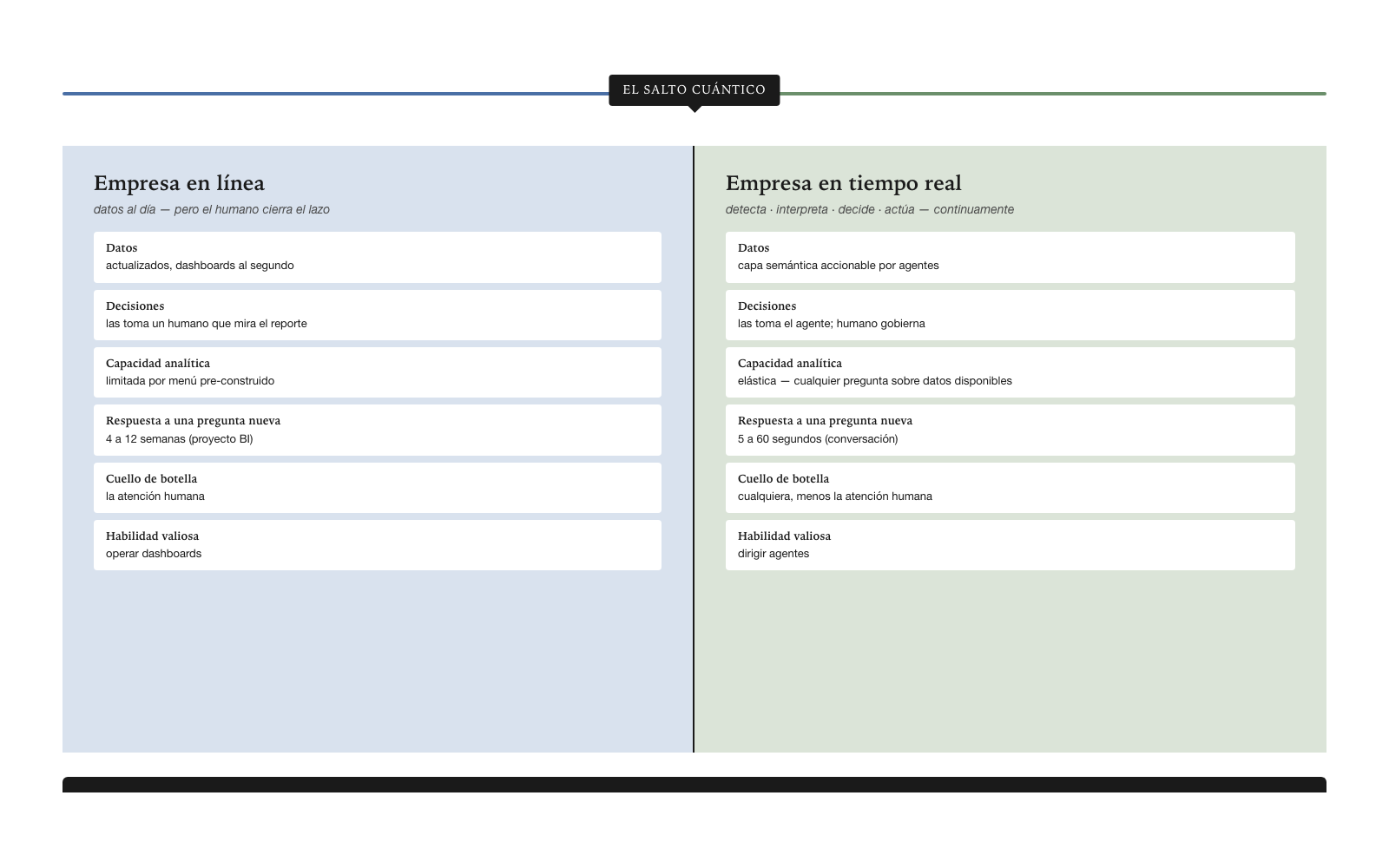
The transition between the two cycles gives rise to an organizational distinction worth coining carefully, because it will be a recurring reference throughout the rest of the book. An online enterprise has its data up to date, its dashboards current, its information accessible. But it depends on a human looking, interpreting, and deciding. It lives with the classic cycle, optimized to the maximum. A real-time enterprise, by contrast, does not merely access information: it detects, interprets, decides, and acts continuously and autonomously, within governed frames. It lives with the agentive cycle. The boundary between the two is exactly what the collapse of the cost of the analytical question enables — it is what we call the Quantum Leap, the event from which the very nature of the operation changes. Before the Leap, an organization can have the best infrastructure in the world and still be an online enterprise. After the Leap, the same infrastructure becomes the substrate of a real-time enterprise.
The distinction matters because it captures something that traditional BI maturity metrics do not. An organization with perfect dashboards, data updated to the second, and the whole BI team running like clockwork, is still an online enterprise if the humans are still the ones who look and decide. The real-time enterprise is not the faster version of the online enterprise — it is something else. The difference is not one of speed, it is one of operating model.
In the vocabulary of the architecture the rest of the book develops,
the online enterprise and the real-time enterprise are points on
the temporality continuum of the components that sustain the
operation: “real time” is not enabled by choosing a channel that pushes
data more often, but by giving continuous temporality
to the components that operate on the organization’s behalf. The spec of
manifestation and temporality
(discrete/continuous) lives in Chapter
5 §2.
Cube puts it without rhetoric: “The modern data stack is beginning to show its age.” BCG takes it to the operational plane, describing how agentive AI orchestrates actions across the whole value chain, “closing the loop between insight and execution.” The phrase is exact: the classic cycle left the loop open — it ended with a recommendation that the human closed with their decision. The agentive cycle closes the loop — the system itself decides and executes, within the frames the human defined. It is a distinct paradigm, not an increment over the current one.
The crossing is not a switch: an organization goes through it gradually, and within it the proportion between assisted work (the agent as a reactive Assistant) and autonomous work (the Autonomous Agent that closes the loop) shifts as it matures. By way of illustration:
| Stage | Assistant | Autonomous Agent |
|---|---|---|
| 1 · Initial | 90 % | 10 % |
| 2 · Adoption | 70 % | 30 % |
| 3 · Maturity | 50 % | 50 % |
| 4 · Advanced | 30 % | 70 % |
The figures are indicative, not measured: they mark the direction of the shift — from a world where the human governs every step to one where the agent sustains the operation and the human governs the frames. The Assistant vs Autonomous Agent distinction is developed in Chapter 5 §5.
Three axes of deep change
An organization that crosses the Nadella Line experiences three simultaneous axes of transformation — the three axes group the six dimensions of the crossing: the human-information relationship and the roles of human work condense into the first; the data and the operating model, into the second; governance and the economics of information, into the third. Taken in isolation, each axis sounds like a reasonable improvement. Taken together, they constitute a change of operating model. The warning, recurrent among the firms that have documented the field: advancing on one axis alone without the others produces successful pilots but no real transformation. The three are interdependent.
From consuming information to governing agents
The first axis changes the human’s relationship with information. In the current paradigm, the knowledge worker is a consumer of information: someone builds reports, someone builds dashboards, and the worker reads, interprets, and decides on them. The valuable skill is data literacy — knowing how to read tables, understand visualizations, formulate hypotheses from numbers. The value is in understanding the information.
In the emerging paradigm, the knowledge worker moves toward a different role: designer and governor of agents. People stop looking at reports and move to designing the rules, the thresholds, the protocols under which agents monitor, interpret, and act. The valuable skill is the design and supervision of autonomous systems — knowing how to formulate the right rules, knowing how to evaluate the agent’s aggregate behavior, knowing how to detect when the agent operates out of range. The value is in governing intelligent action, not in consuming information about it.
The change is radical but not sudden. The CFO who in the current paradigm reviews a cashflow dashboard every morning, in the emerging paradigm defines the thresholds and protocols that a financial agent executes autonomously. The agent monitors continuously, executes liquidity-management actions within the limits the CFO defined, and escalates to the CFO only when it approaches the thresholds or when it detects anomalous conditions. The CFO no longer looks at the dashboard — they look at the agent’s behavior, adjust the thresholds when they learn something new, intervene when the agent notifies them of an anomaly. The CFO is still the CFO, but their daily work changed in nature.
McKinsey describes this transition precisely in its report on the “Agentive Organization”: employees move from executing tasks to orchestrating outcomes, supervising agents, setting objectives, and managing trade-offs. The recurring phrase among analysts — “humans above the loop” — captures the shift. The human is not outside the decision loop, nor inside it: they are above the loop, defining its parameters and supervising its aggregate behavior. McKinsey estimates that seventy-five percent of current roles will require redesign, upskilling, or reassignment by 2030.
BCG documents a concrete organizational consequence of this shift: forty-five percent of AI leaders expect to need fewer layers of middle management. The reason is structural. Middle management exists in large part to coordinate execution across levels — passing instructions from the executive level to the operational level, monitoring that they are executed, reporting back. When the agent executes autonomously, that coordinative role loses its necessity. What survives of middle management is the part that contributes professional judgment: defining the right rules, handling complex exceptions, mediating between objectives in tension. The pure coordinative part disappears.
New roles appear, symmetrically. An analysis by CIO.com enumerates them in detail: AI Agent Orchestrator (the person responsible for the fleet of agents operating in a function or area), Human-Agent Interaction Designer (the person who designs how humans interact productively with the agents they govern), AI Ethics & Governance Specialist (the person who ensures the agents operate within ethical and regulatory limits), AgentOps Specialist (the equivalent of the DevOps Engineer but for fleets of agents). It is a new org chart. It does not replace the traditional org chart immediately — it coexists with it for years — but it reflects the shift of human work toward governing agents that execute.
From architecture for humans to architecture for agents
The second axis changes the data and the underlying architecture. This is the dimension least visible to the executive and most critical to the technical architect. The reason: the data architecture of the current paradigm is optimized for humans to query — and that is structurally incompatible with agents querying correctly.
The current paradigm assumes that the final consumer of the data is a human operating an application. Data warehouses are optimized for SQL queries written by analysts. Data quality means cleanliness: rows without nulls, consistent formats, dates in their place. Data models are designed to feed visualizations — Power BI, Tableau, Looker. The integration between systems operates by batches or on demand, at frequencies the human can tolerate.
The emerging paradigm changes each of these assumptions. Data is consumed by agents, which do not read rows — they interpret meaning. Warehouses on their own are insufficient: they need an explicit semantic layer on top, where the agent reads not only the tables but the intent of the tables: what this indicator means, how it relates to those others, what transformations are legitimate, what special cases apply. Data quality ceases to mean cleanliness and comes to mean actionability — why an impeccably clean datum can be worth less to an agent than an imperfect but context-rich one is something the canonical application of Chapter 7 develops.
AtScale measured this difference quantitatively. According to AtScale, agents that query data without a semantic layer fail on more than eighty percent of queries — they generate incorrect SQL, misinterpret metrics, hallucinate relationships that do not exist; the same agents with an explicit semantic layer reach, in the same AtScale study, very high accuracy. The conclusion AtScale draws admits no ambiguity: “For AI agents, the semantic layer is not a nice-to-have — it is the foundation that makes AI truly useful.” Chapter 7 applies this result to the architecture of the canonical case (Varnished Kimball).
ThoughtSpot coined the term Agentic Semantic Layer to describe the semantic layer designed natively for agents — dynamic, context-aware, connected to the agent’s flows. Salesforce, in its agentive-enterprise architecture, proposes an Enterprise Knowledge Graph as the central layer — a knowledge graph instead of a dimensional model, because the graph captures relationships the two-dimensional table cannot. Databricks talks of unifying infrastructure, data, and semantics to enable Agentic BI. Each of these vendors is attacking, from its own angle, the same problem — the one the canonical application of Chapter 7 states as a principle: data alone is not enough for the agent.
The industry is still debating the details — knowledge graph versus semantic layer versus ontology versus extended dimensional model — but the recognition that something new is necessary is already consensus. Informatica frames it candidly: “Because agents act without human approval loops, the data they use must be fully trusted, verified, and monitored.” And it proposes explicit data-quality SLAs: less than five minutes of freshness for transactional agents, less than one hour for analytical agents. The old SLAs — refreshing the data warehouse every night — do not serve systems that act in real time.
Deloitte found that forty-eight percent of organizations cite data discoverability as the principal barrier to their agentive strategy, and forty-seven percent cite reuse. The data exists, but the agents cannot find it or cannot interpret it. It is an architectural problem, not one of quantity. The transition from the current paradigm to the emerging one demands a paradigm shift in data architecture: from ETL pipelines designed to feed dashboards to semantic fabrics designed for autonomous reasoning.
From access governance to autonomy governance
The third axis changes how the organization exercises control over what the system does. It is the axis where most agentive projects fail, according to the field data, and for that reason it deserves careful attention.
Traditional IT governance asks: who can see what data?. The control model is access: authenticated identities, assigned roles, permissions granted over specific resources. The question is static (permissions rarely change) and discrete (a user has or does not have access to a resource). The traditional tools — IAM (Identity and Access Management), SSO, RBAC — are optimized for this model. They work well because the subject of access (the human) has a stable identity and the object of access (the resource) has clear granularity.
Agentive governance asks something different: what can an agent do, under what conditions?. The subject of control is not a human — it is an agent acting on behalf of a human or organization. The object of control is not an isolated resource — it is a sequence of actions the agent can execute autonomously. The question is dynamic (the conditions change with context), continuous (the agent acts all the time, not only when someone points the cursor), and multi-dimensional (what action, on what data, with what impact, under what threshold).
Traditional IAM tools are insufficient in this model. They are designed for human subjects with stable identity and discrete permissions, not for agents that act continuously with varying degrees of autonomy. The organization that tries to govern an agent with classic permissions quickly discovers that the model does not capture the questions it needs to answer: can the agent execute bank transfers? Yes, but up to what amount without human approval? during what hours? with what level of prior validation? with what subsequent audit? Each question demands a new mechanism that the classic access model does not have.
Regulators have recognized this shift faster than the industry usually accepts. Singapore’s IMDA published in January 2026 the first state framework of governance for agentive AI: the Model AI Governance Framework for Generative AI (MGF), which — despite carrying generative AI in its name — devotes its body to agents acting with autonomy. The framework establishes, with a clarity uncommon in early regulation, that although the agents act autonomously, “human accountability continues to apply”. Organizations must make human accountability meaningful and human-in-the-loop effective over time. The World Economic Forum proposes progressive governance: logging and traceability for all agents, identity tagging per action, real-time monitoring. Its key distinction: “autonomy entails decision-making flexibility; automation emphasizes execution reliability” — they are design choices, not inherent properties of the system. The organization chooses how much autonomy to give the agent; it does not inherit it as a technical property of the system.
BCG reports that fifty-eight percent of heavy AI adopters expect a fundamental change in their governance structure in the next three years, and a third believe AI will have more decision authority in the same period. NACD — the national association of corporate directors in the United States — warns that agentive AI impacts board oversight, regulatory compliance, and risk exposure. KPMG’s phrase sums the period up well: “The winners won’t be the ones with the most pilots but the ones investing now in scalable data architectures, agent governance models, and workforce readiness.”
The figure that worries most, however, is the operational one. Gartner predicts that more than forty percent of agentive AI projects will be canceled before the end of 2027 — due to costs, unclear business value, or inadequate risk controls. Governance is not optional; it is what separates pilots from production. The scale of the problem is significant: eighty percent of organizations report risky behaviors by their agents — unauthorized data access, unexpected interactions, out-of-range decisions — and only twenty-one percent have mature governance models. ISACA stresses that agentive AI presents a growing challenge for audit functions because its decision processes lack clear traceability.
The message of the data is sharp. The organizations that survive the crossing will be those that have invested in autonomy governance with the same seriousness with which they invested in access governance over the last twenty years. Those that treat the problem as a late application of the old tools — one more permission in the IAM, one more role in the SSO — will end up on the wrong side of that projection. And autonomy governance is not built in the last month before launch — it is designed from the start, in the very architecture of the system. It is what Chapter 5 develops under the name Trust Infrastructure.
The nature of the transition
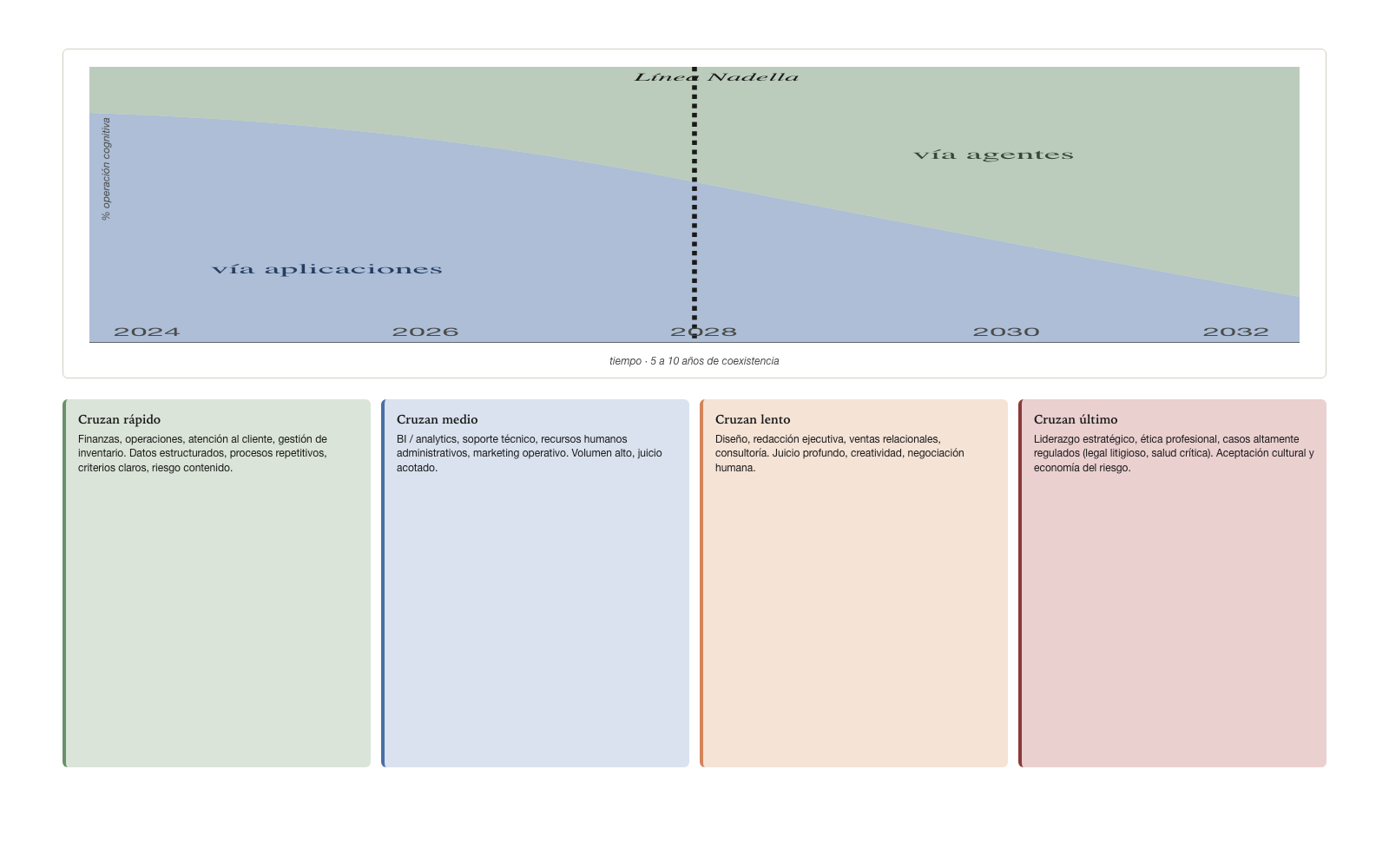
There is a risk of reading the consequences of the crossing as if they were a single event — the day the organization passed to the Agentive side. That reading is mistaken and, in practical terms, dangerous: it leads to planning the transition as a big bang that almost always fails. The reality is evolutionary coexistence: the current paradigm and the emerging one coexist for years, with the proportion changing gradually from one toward the other.
The existing infrastructure — data warehouses, ETL pipelines, traditional BI tools, ERPs, CRMs — does not disappear when an organization crosses the Nadella Line. Its role changes. It ceases to be a surface with which the human interacts and becomes a data source consumed by agents. The traditional architecture remains valid for large-scale historical data warehousing, for highly complex analytical models that require pre-computation, for pipelines with very specific business logic, for regulatory requirements of retention and formal lineage. What changes is not whether those systems exist — it is who consumes them. In the early stages, ninety percent of consumption is by humans via dashboards and reports; the agent is an occasional assistant at the margin. In the advanced stages, the agent orchestrates most of the analytical queries and the traditional infrastructure operates invisibly underneath, feeding it.
Each stage of the transition does not invalidate the previous one — it subsumes it.
An organization advanced in the transition did not eliminate its data warehouse. It integrated it into a semantic fabric that agents consume autonomously. The online enterprise does not disappear when the real-time enterprise emerges — it becomes its foundation. This is a critical reading so as not to fall into the opposite error of the “big bang”: that of agentive fundamentalism, which discards all the existing infrastructure and tries to rebuild from scratch. The serious organization recognizes that twenty years of investment in traditional BI built an asset — the data is clean, the models are agreed upon, the pipelines are reliable — and that this asset is exactly what the agent needs underneath. To throw it away and start over is to renounce the asset. To keep it and add an agentive layer on top is to capitalize on it.
Evolutionary coexistence is not a hope — it is the documented pattern of every interface transition the industry has already crossed. When the PC challenged the mainframe, the prophecy was extinction; the inflection point came in 1984 — desktop computer sales surpassed mainframe sales for the first time — and yet mainframes today process between 2.5 and 3 billion transactions a day, sustaining the world’s financial markets. When the web challenged installed software, and when the cloud challenged on-premise, the pattern repeated, always with four constants: the initial prediction is extreme (total death of what came before); the reality is coexistence (the “doomed” technology finds niches of irreplaceable value); the real timeline multiplies the predicted one by three to five; and the stable state is hybrid — layers stratify, they do not replace one another. The Nadella Line will inherit the pattern: the crossing will be asymmetric, slower than its headlines, and applications will long survive as substrate — which is exactly what evolutionary coexistence plans for instead of denying.
The transition has, in addition, two asymmetries worth recognizing. The first, asymmetry across functions: not all functions cross at the same pace. Repetitive functions with structured data — finance, operations, customer service, inventory management — cross fast, because the economics are evident and the risk of error is contained. Creative functions or those of deep judgment — design, strategy, negotiation — cross more slowly, not for technical incapacity of the agents but for cultural acceptance and the economics of risk. Forcing a uniform crossing across all functions is one of the most common antipatterns in failed agentive transformation programs. Serious organizations let each function cross at its own pace, with specific plans per area, rather than imposing a single calendar.
The second asymmetry is temporal: organizations that invest early in agentive architecture pay the cost of exploring before having mature reference points, but they also capture the learning that comes from operating the new model for longer. Those that wait for the field to mature pay less exploration cost but reach the market with less operational experience. The choice between the two positions is not obvious — it depends on risk appetite, on competitive position, on the decision-maker’s time horizon. But the choice must be conscious. Remaining in the middle — investing enough to have a pilot but not enough to reach production — is the worst possible position. It is exactly the position that swells Gartner’s cancellation projection.
The state of the field
Treating the Agentive World as a distant horizon is a diagnostic error. The field data at the start of 2026 documents a transition already under way, with a speed significantly greater than what traditional marketing suggested eighteen months ago. Three figures give dimension to the phenomenon and frame the reading of the rest of the book.
The first: by the end of 2026, forty percent of enterprise applications will include AI agents, compared to less than five percent in 2025. The projection is Gartner’s, and the order of magnitude — an eightfold growth in twelve months — is what makes it remarkable. It is not the absolute figure that matters; it is the slope. A slope like that implies the transition is accelerating, not stabilizing.
The second: by 2028, at least fifteen percent of daily operational decisions will be made autonomously by agents, with no human in the decision loop. The figure is a Gartner projection. Fifteen percent seems little, until one calculates how many operational decisions a mid-sized company makes per day — on the order of tens of thousands across all its areas — and understands that fifteen percent is a significant volume of daily autonomous operation, with regulatory, organizational, and technical implications that companies have not yet fully mapped.
The third: the global agentive AI market goes from 7.3 billion dollars in 2025 to a projected 139.2 billion by 2034 — a compound rate above forty percent per year sustained over a decade. This figure is the collective bet of capital on the agentive horizon. When capital bets like that, it does not guarantee that the transition will occur as predicted — but it does guarantee that the organizations betting against it will have to justify the bet against massive investment in the opposite direction.
There are three possible readings of these data, all valid, and the serious organization must hold all three simultaneously without their contradicting one another. The first reading: the crossing is happening. It is not a future scenario over which to debate whether it will arrive — it is a measurable present. The second: but most are poorly prepared — the governance data already cited (widespread risk, scarce maturity, projects on the way to failing) confirms it. The third: the difference between success and failure is structural. The organizations that survive the crossing will be those that have invested in formal agentive architecture, not in isolated pilots without discipline.
The three readings are, ultimately, the same. There is a real transformation occurring. There is a real cost to doing it badly. And the difference between those who will do it well and those who will do it badly is not subtle — it is architectural.
The architectural obligation
The consequences of the crossing that this chapter has documented are not aspirational — they are technical requirements. Each consequence has a direct architectural implication, and the list of implications, read as a whole, is almost exactly the list of the four layers and the cross-cutting infrastructure that Chapter 4 will propose as the formal architecture.
The collapse of the application as interface demands a channel-agnostic Interaction layer. If the human is going to converse with agents instead of opening applications, the system must be able to manifest itself coherently in chat, voice, corporate channels, GUI on-the-fly, and eventually in any new channel that appears. A rigid Interaction layer, tied to a particular surface, fails in the Agentive World.
The new economics of information demands a Cognition layer that can reason over data in real time, multi-LLM, capable of applying specialized knowledge and of delegating repetitive tasks to another layer that executes them without invoking it each time. A monolithic cognition, tied to a single provider, fails when the economics of operation demand otherwise.
The transformation of human roles toward governing agents demands that the agent have persistent life — that it not be merely a reactive assistant that responds and forgets. An Autonomy layer where the agent can maintain state, execute continuously, monitor, and act on its own initiative is what makes the human above the loop instead of in the loop. Without that layer, the human remains a bottleneck even while believing they are governing.
Autonomy governance demands a control point where policy is exercised before execution. An Access layer where every action of the agent on the real world passes through policy validation, auditable logging, and configurable controls is what separates pilots from production. Without that layer, the system is indefensible both regulatorily and operationally.
And the transition from pilots to production demands a cross-cutting trust infrastructure — one that does not live in a specific layer but cuts across all four. It is what Chapter 5 develops under the name Trust Infrastructure: five pillars — Governance, Auditing, Validation, Resilience, Transparency — exercised at different points depending on the case but which together sustain the organization’s trust in what the system does.
Each requirement is a layer. Each layer is the answer to a consequence of the crossing. The agentive architecture is not an abstract proposal designed on a whiteboard — it is the list of things that must be resolved so as not to swell those cancellations. That architecture, its layers, its primitives, its formal interfaces, is what the rest of the book develops.
Whoever has followed this chapter now understands what changes upon crossing the Nadella Line, why the crossing is systemic, and what is demanded of an architecture that aims to sustain it. The following chapters deliver that architecture. The reader who is going to make stack decisions on a five-year horizon will find in them the discipline that prevents it.
Visual summary
| Dimension | Before the crossing | After the crossing |
|---|---|---|
| Interface | Applications (GUIs, menus, screens) | Conversation with agents |
| Data | Data warehouses optimized for SQL · quality = cleanliness | Semantic layers where agents reason · quality = actionability |
| Human roles | Consumers of information · executors of tasks | Designers and supervisors of autonomous systems |
| Economics of information | Each new question = a project (weeks) | Each new question = a conversation (seconds) |
| Governance | Who can see what data · static permissions | What an agent can do, under what conditions |
| Operating model | Centers of competence · specialized functions | Agent factories · ecosystem orchestration |