AgencyDomains
Architecture of the Agentive World
A note on the version. This is the first edition (v1.0; this revision is v1.2): the first stable public release. From here the append-only rule governs figure numbering — every new figure takes the next available number, with no renumbering of existing ones. Comments and errata are welcome in the repository. The version history lives in
CHANGELOG.md.
About this book
The AI industry builds agents with the same attitude it built web applications with in 2005: each vendor with its own stack, no common contracts, no clear separation of concerns. Gartner projects that more than forty percent of agentic AI projects will be cancelled before the end of 2027 because of costs, unclear business value, or inadequate risk controls. Only twenty-one percent of organizations have mature governance over their agents. The root cause is structural: the category lacks a shared formal architecture — and has no concrete name for the minimal unit of deployment.
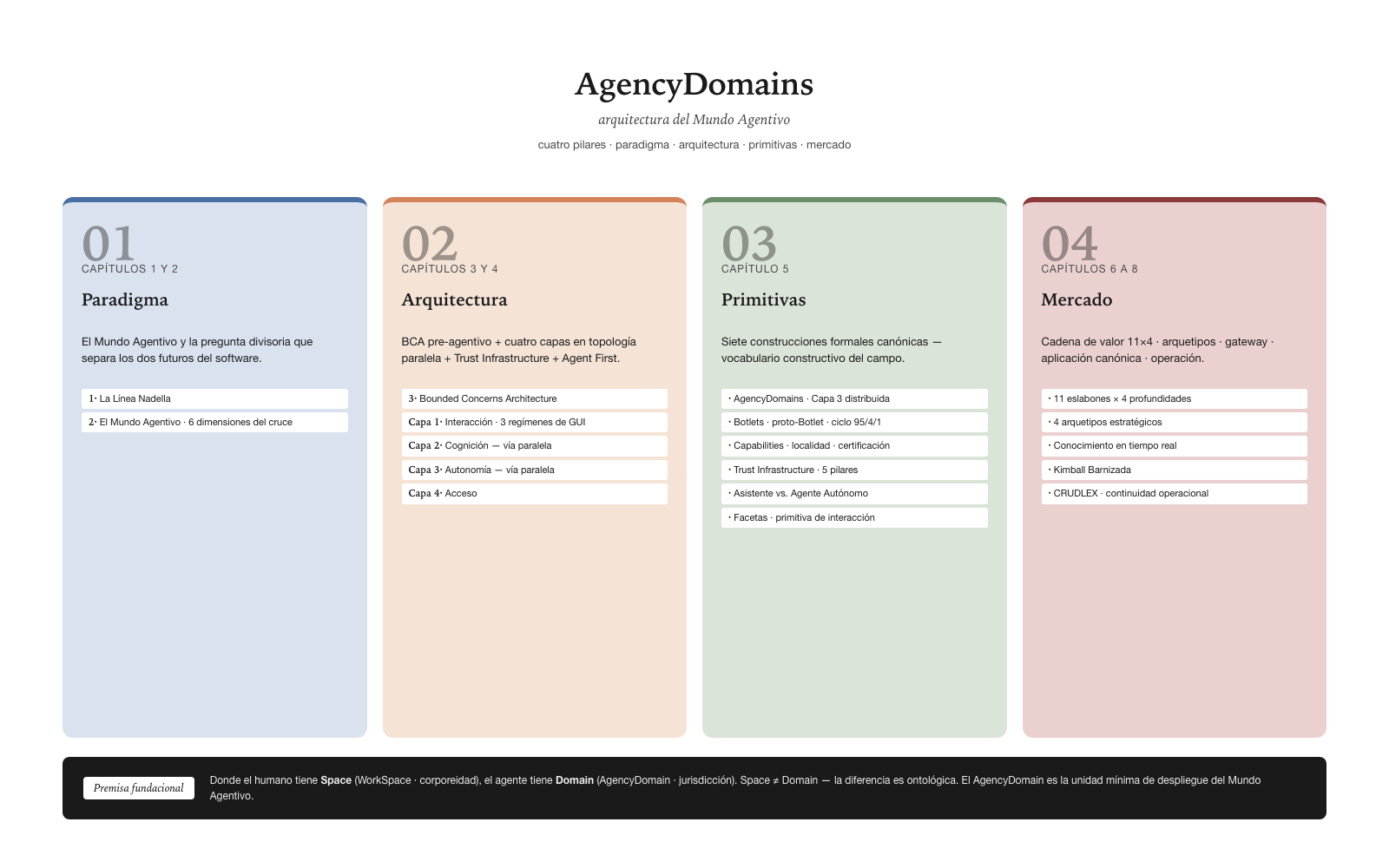
This book proposes that name and that architecture. The minimal unit of deployment is the AgencyDomain — the computational scope where agents dwell, Botlets execute, and Trust Infrastructure is exercised. Around the AgencyDomain, the book defines a paradigm (the Agentive World — post-applications), a formal architecture (four layers with distinct concerns, organized in a parallel topology), a set of canonical technical primitives (Botlets, Capabilities, Trust Infrastructure), and a two-dimensional model for placing any actor in the AI market (the AI value chain — eleven links × four depths).
The book is product-agnostic. The formal constructs described here admit multiple implementations. The public reference implementation —Vergis— is developed in Chapter 9.
Structure
| Chapter | Content |
|---|---|
| Preface | Origin of the book · who should read it · how it is organized · on terminology |
| 1 · The Nadella Line | The canonical question · Agentic vs Agentive · the CEOs · why it matters strategically |
| 2 · The Agentive World | The consequences of the crossing · organizational transformation · the new economics of information · field data |
| 3 · Bounded Concerns Architecture | The pre-agentive state · three layers and seven separations · the seventh Procedural/Agentic separation · mapping to the Agentive World |
| 4 · Agentive Architecture | The four layers in parallel topology · the agent’s three
times (Preparation · Attention · Engineering) · Layer 2 ↔︎ Layer
3 interface via MCP · cross-cutting Trust Infrastructure ·
the Agent First principle · GUI generated on-the-fly ·
composition of Layer 1 (shell · view · operation ·
multi-view PI and drill-through) · Facet vs
Botlet |
| 5 · Primitives | AgencyDomains (with distributed Layer 3 + portability) · Botlets (with maturity + seed/emergent + proto-Botlet · manifestation · temporality + generic Botler) · Capabilities (strict to Layer 2 + locality + regulatory certification + portability · feature · Connector · Template) · Trust Infrastructure (with operational continuity + declarative quality contract) · Assistant vs Autonomous Agent · Facets (sixth primitive — Layer 1) · declared bounded interaction · Agentlets (eighth primitive — packaged routine judgment) |
| 6 · Market | The AI value chain · depths and archetypes · per-link deep-dives · the Carbon World |
| 7 · Canonical applications | Real-time knowledge · Varnished Kimball · conversational BI |
| 8 · Operation | Trust Infrastructure operationalized · CRUDLEX · policies · operational business continuity |
| 9 · Vergis | The reference implementation · note on the scope of the canon · the Vergis · Botler · Mira · Daftar scheme · what it includes · production grade · adoption model · common catalog and network effects |
| Epilogue | Evolution frontier · four frontiers (non-LLM cognition · federation · the Carbon World · the institutional horizon) · essay on the Botlet generations |
| Appendices | Glossary · references · colophon |
Who should read this book?
This book is addressed to:
- Systems architects who design or evaluate agentive platforms and need a common frame for reasoning about separation of concerns, governance, and resilience.
- CTOs and technical leaders who must make agentive-stack decisions on a three-to-five-year horizon.
- Strategists and consultants who advise companies on their transit into the Agentive World.
- Researchers and academics interested in the formalization of agentive architecture as a category of study.
- Product builders who want to situate their contribution in a value chain broader than their particular product.
The book is introductory in the sense that it assumes no prior knowledge of specific implementations, but it does assume basic familiarity with distributed systems, language models, and operating systems in production.
How to cite
Obach-Renner, César. AgencyDomains: Architecture of the Agentive World. First edition v1.2. GegoLabs, 2026.
The Trilogy
This book is volume III of the Agentive World Trilogy. The transition that occupies the trilogy is a single one: from the world where people open applications to work, to the world where AI agents are the interface of work. The three volumes answer, in order, the three questions of that transition — and each one reads complete on its own:
I · The Real-Time Enterprise — The Agentive World Where are we going? — the destination. For those who want to see the world on the other side of the transition: how people work, decide, and compete when the enterprise operates in real time — told in its four faces.
II · AURA — The Agentive Path Which way? — the route. For those who have to make the crossing: leaders and advisors of the transformation. Its five specifications are standalone instruments for the agentive era — each one can be used separately, without the rest of the book:
| Spec | What is it? | Used alone, what does it give you? |
|---|---|---|
| IRIS | A maturity model of organizational intelligence | Locates your organization on the road from data to action |
| MOTOR | A maturity model of organizational automation | Measures how advanced your organization is at process automation |
| Data Canon | The evolution of the decentralized data-management model (Data Mesh) | Defines how the organization’s data is governed |
| Wingmap | The evolution of business process management (BPM / process mining) | Reconstructs processes and information flows without interviews |
| Use Cases | A portfolio framework, illustrated with 100 use cases and 30 value solutions | Prioritizes where to start, according to your maturity |
III · AgencyDomains — Agentive Architecture (this book) How do we get there? — the vehicle. For architects, CTOs, and builders of agentive platforms: the formal specification of the Agentive World.
Vergis — Agentive Technology (not a book: it’s code) What do I start with today? — the keys. For anyone who wants to start making all of this real: the reference implementation of the architecture, open source, at https://github.com/gegolabs/vergis.
Start with The Real-Time Enterprise if you need to convince yourself — or someone else — that the transition is for real; with AURA if you have to lead it; with AgencyDomains if you have to build it; with Vergis if you want to see it running. The full trilogy lives at https://agencydomains.org.
License
This book is published under the GNU Free Documentation License v1.3. The reader may copy, distribute, and modify the work under the terms of the license. The invariant section is the Preface.
The reason for the open licensing is deliberate: the Agentive Architecture aims to establish a category that serves the whole ecosystem, not a particular vendor. By adopting and developing it, other companies, researchers, and builders enrich it and consolidate it as a de facto standard. This serves the field and simultaneously reinforces the authority of those who coined it.
Contact information
- Website: https://agencydomains.org
- Repository: https://github.com/gegolabs/agencydomains.org
- Errata and comments: https://github.com/gegolabs/agencydomains.org/issues