Chapter 1 · The Nadella Line
This whole book turns on a single question — and on the architectural answer that question demands. The question was dropped, almost in passing, by Microsoft’s CEO; this chapter turns it into the frontier that today splits the industry in two: the Nadella Line. The answer — the formal construct that gives the book its title — will come in due time, once the reader has the full paradigm in hand.
In December 2024, Satya Nadella sat across from Brad Gerstner and Bill Gurley on the BG2 podcast and let drop a line his interviewers did not expect. The conversation had been about the future of productivity, the role of copilots, how Microsoft was thinking about the next decade of enterprise software. Nadella, with no prophetic tone, almost as if stating the obvious, offered the line that would give this book its name:
The notion that business applications exist — that’s probably where it all collapses, in the era of agents.
The statement went almost unnoticed. Dozens of podcast clips were published, and far more was discussed about OpenAI and reasoning models, about the economics of compute, about NVIDIA’s role. But that line contained a prediction which, if it proves correct, changes the entire order of modern enterprise software. The prediction was not about AI — it was about applications: specifically, about the claim that they will cease to exist as a category.
Nadella was not talking about evolution. He did not say “applications will get smarter.” He did not say “applications will have embedded copilots.” He said collapses. And he said where it all collapses — singular, defining. If Microsoft, owner of the most widespread office suite on the planet, predicts that business applications cease to exist, one has to understand why.
The full quote deserves a careful read, because it contains more than the forecast — it contains the mechanics of the collapse:
“…they are essentially CRUD databases with a bunch of business logic. The business logic is all going to these agents, and these agents are going to be multi-repo CRUD: they’re not going to discriminate between what the backend is. They’re going to update multiple databases, and all the logic will be in the AI tier, so to speak. And once the AI tier becomes the place where all the logic is, then people will start replacing the backends.”
Read it slowly: Nadella describes two phases. First the interface collapses — the logic migrates to the agent tier, which operates over the repositories without discriminating the backend. Then, with the logic already in the AI tier, the backends themselves start being replaced. This book formalizes exactly that mechanics: the agent tier that concentrates the logic is the architecture of Chapter 4; the governed “multi-repo CRUD” is what Chapter 8 operationalizes as CRUDLEX; and the backends that persist invisible, consumed via Connectors, are Layer 4. The short quote gives the headline; the full quote gives the blueprint.
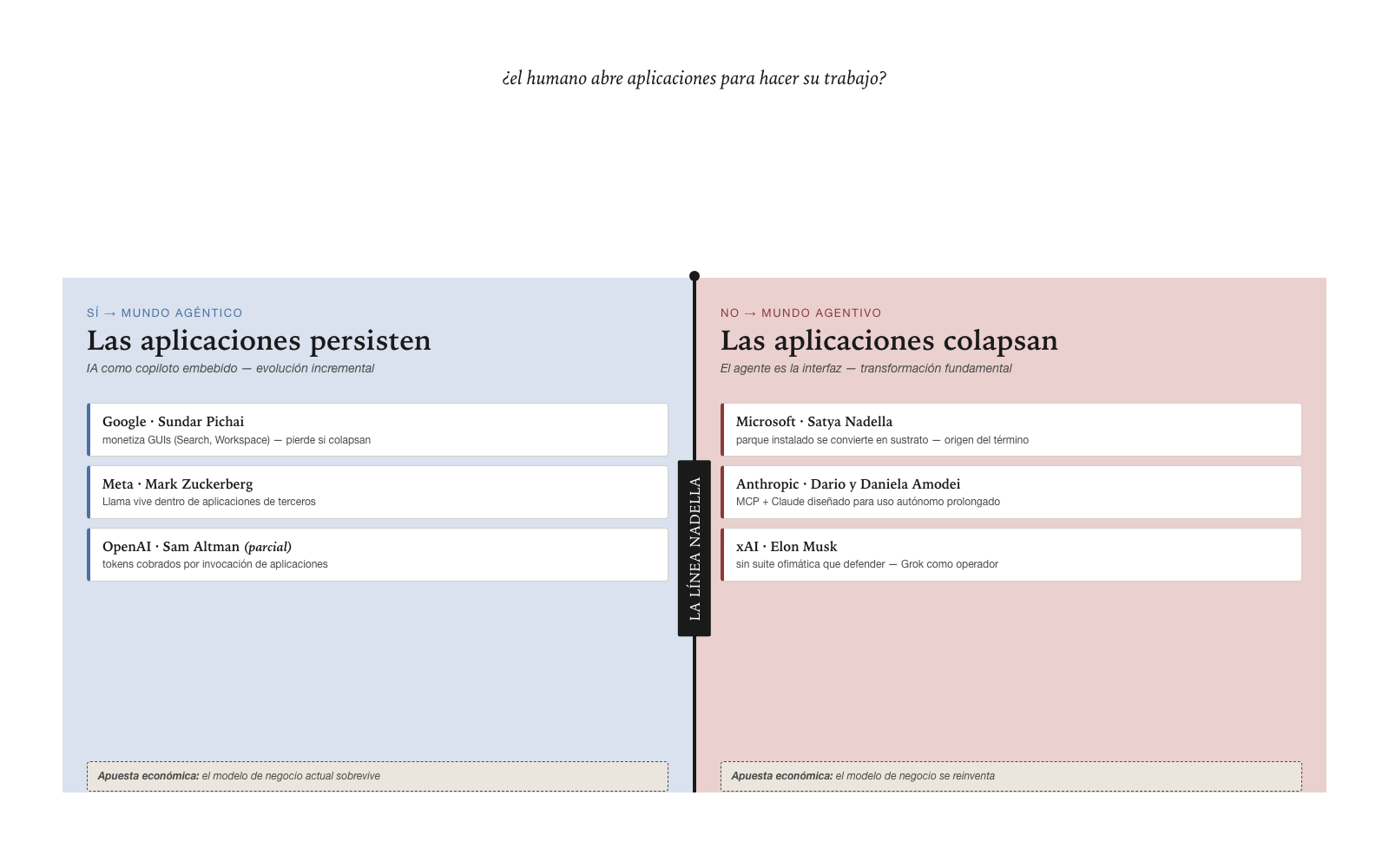
This chapter is the answer. What we will call the Nadella Line is the conceptual boundary between two irreconcilable futures of software — one where applications persist, another where they collapse. The entire AI industry, consciously or not, is betting today on one side or the other. Every stack decision an organization makes today is, implicitly, an answer to a single question.
The question that divides the industry
The question is deceptively simple:
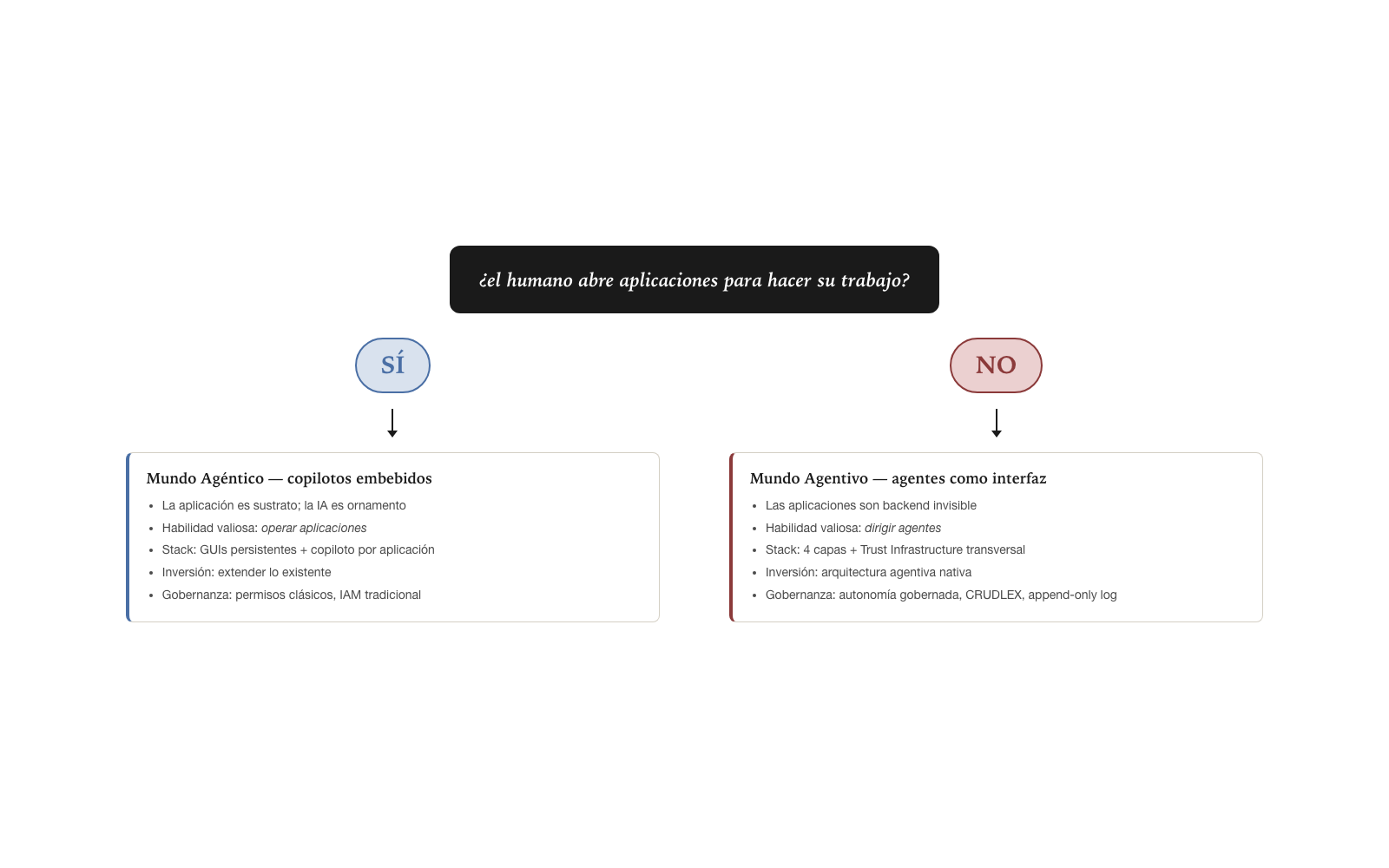
Does the human open applications to do their work?
If the answer is yes, the organization lives on what we call the Agentic side of the line. The traditional interface — Excel, Salesforce, Power BI, Outlook, ServiceNow, Confluence — persists. AI arrives as an embedded copilot in each of those applications: the “Suggest formula” button in Excel, “Compose email” in Outlook, “Ask your data” in Power BI. The application is the substrate; AI is sophisticated ornament on top.
If the answer is no, the organization has crossed to the Agentive side of the line. Applications, as interface, have disappeared. The human does not open Salesforce to ask about their pipeline — they ask an agent. The human does not open Power BI to review quarterly margins — they ask an agent. Applications may go on existing underneath, as invisible backend infrastructure the agent queries, but the human no longer sees them. Their primary interface with the digital world is conversation with an agent that has access to everything.
The difference between the two sides is not one of degree — it is categorical. A very advanced Agentic World, with perfect copilots in every application, remains Agentic as long as the human keeps the habit of opening applications. A nascent Agentive World, where conversation with an agent is still clumsy, has already crossed the line if the human has stopped opening applications to do their work. The boundary is set by the human’s behavior, not by the technical sophistication of the system.
The question matters because it admits no honest middle ground. A human who opens twenty applications a day and a human who converses with an agent all day are two distinct operating models of professional work, and the technical architectures that support them are incompatible. An organization betting that applications persist builds one thing; an organization betting that they collapse builds another. You cannot build both at once with coherence.
What the line separates — Agentic and Agentive in detail
The Agentic paradigm describes the horizon where AI agents are complementary tools within a universe of applications that survives. The traditional interface persists. The employee remains the operator of the software — opens the applications, navigates their menus, presses their buttons — only now each application has copilots that accelerate what the human did by hand. Microsoft 365 Copilot inside Word, Gemini for Workspace inside Google Docs, Salesforce Einstein inside Salesforce, GitHub Copilot inside the IDE.
The agentic paradigm is incremental evolution. The way of working does not change: the speed does. The financial analyst still builds their model in Excel — only now they ask the copilot to suggest the right formula instead of looking it up in the documentation. The consultant still drafts their proposal in Word — only now the copilot helps them structure the first draft. The executive still reviews dashboards in Power BI — only now they can ask the copilot to explain an anomaly. The required skill is a natural extension of the current skill: the employee who knew how to operate Excel now learns to operate Excel with a copilot. Same application, same mental structure of the work, better speed.
The Agentive paradigm describes a qualitatively different horizon. In the Agentive World, agents are the interface. Applications, as a category perceptible to the human, collapse. The financial analyst stops opening Excel: they ask an agent directly why margins fell in Q3. The agent, underneath, queries systems that may or may not include Excel databases — but the human never sees the cell. The consultant stops opening Word: they dictate the structure of the proposal to an agent and review the result. The executive stops opening Power BI: the agent proactively sends them the anomalies it detected, in conversational form, with no dashboards in between.
The agentive paradigm is fundamental transformation. The way of working changes. The required skill is redefined: it is no longer about knowing how to operate applications but about directing agents — framing requests well, validating responses, governing what agents decide and execute. The analyst who in the Agentic World prided themselves on knowing Excel in depth, in the Agentive World prides themselves on knowing how to pose analytical questions the agent can answer. The specific application — Excel, Power BI, Salesforce — becomes an implementation detail the human never touches.
The Agentive World does not imply that applications disappear entirely. It implies that they stop being the human’s interface. Salesforce, as a system that stores customer information, can keep operating perfectly well in the Agentive World — only the agent queries it via API, not the human via UI. The application becomes invisible backend infrastructure. It survives as a repository of data and business logic, but loses its role as work surface. This distinguishes the agentive scenario from an apocalyptic one where “all software dies” — the software survives; what dies is the GUI as the primary interface of cognitive work.
Agentive World and agentic world — a deliberate typographic distinction
The English-speaking industry took agentic AI as a general term for any AI that acts with some degree of initiative. The term circulated fast and filled with heterogeneous content: embedded copilots, virtual assistants, autonomous systems. Today agentic AI means whatever a vendor wants to sell under that umbrella. The distinction Nadella made on BG2 — the distinction between the two sides of the line — was buried under the noise of marketing.
This book preserves the distinction that the consolidated industry lost. The distinction is qualitative, not one of degree. Agentic describes the evolutionary mode: agents that complement applications. Agentive describes the transformational mode: agents that replace applications as interface. Agentic says: the tools remain, but now they are smarter. Agentive says: the tools we know disappear as interface; what remains is conversation with agents.
In Spanish, where agentivo and agéntico differ by a single accent, the distinction between the two categories collapses into a change no reader retains — which is why the original edition adopts a deliberate typographic convention. In English the two words are already distinct, but the book keeps the same capitalization rule because it carries a second load: when the terms refer to the paradigm as a named noun — the vision, the category, the side of the line — they are capitalized: the Agentive World, the Agentic World. When the same terms are used as a descriptive adjective — qualifying a system, an organization, an era — they are lowercase: an agentive system, an agentic era, agentive products.
The uppercase / lowercase distinction is what carries the categorical difference. When the reader encounters “the Agentive World is the destination,” they read the noun of the paradigm — the referenceable entity the book defends. When they encounter “building a serious agentive system,” they read the descriptive adjective — a quality of a particular object. It is the same convention serious technical treatises use: Bounded Context in Eric Evans, Aggregate in Domain-Driven Design, Replication in Kleppmann. The canonical concept is capitalized; the descriptive use is lowercase.
The cost of this convention is a microsecond of the reader’s attention when they see the two forms. The benefit is preserving the category. When someone reads “the Agentive World” and it reads differently from a plain “agentive world,” they are grasping exactly the difference the book sets out to defend.
Who bets on each side, and why?
As of early 2026, the industry’s principal players have taken identifiable positions on the Nadella Line question. The divide is not ideological — it is one of business model. Each player predicts the world that protects its competitive position, and although the predictions are published as technical vision, they are ultimately predictions about where their company’s cash flow will survive.
xAI (Elon Musk) also bets on the Agentive World, though from a different position. Musk has no office suite to defend; what he has is Grok integrated into X and the planned integration with Tesla vehicles. His bet is to build an agent that operates autonomously over extended tasks — not as an application assistant, but as a process operator. For xAI, the Agentive World is where its product is relevant: in an Agentic World with copilots embedded in existing applications, Grok competes with consolidated products (Office Copilot, Google Gemini); in an Agentive World, it competes for a new category with no established incumbents. And it is worth recording that Musk’s position is more radical than this book’s: in his formulation, not only does the interface collapse — applications do not survive as backend either (“apps will disappear, like Blockbuster’s VHS tapes”; phones become “edge nodes for AI inference”). The real spectrum has three positions — Agentic, Agentive (the interface collapses; the backend persists, invisible and governed), and extreme Agentive (no backends either) — and this book’s thesis is deliberately the middle one: the one that can be sustained with architecture.
OpenAI (Sam Altman) occupies a more ambiguous position. Publicly, Altman has favored the agentic narrative — “GPT as a complementary tool for existing applications” — consistent with OpenAI’s API-centric business model: the more GPT is invoked from existing applications, the more tokens are billed. But internally, OpenAI has developed growing agentive capabilities (GPTs as in-application agents, Operator as an execution agent, a declared “AGI” vision). The ambiguity reflects the operational reality: OpenAI makes money today in the Agentic World, but its valuation assumes it will make exponentially more in the Agentive World.
Google (Sundar Pichai) bets on a dominant Agentic World. The reason is structural: Google’s business model rests on search and on advertising tied to interfaces — a Google Search page with ads, a Google Workspace dashboard with a monthly subscription. If GUIs collapse, Google loses the surface where it monetizes. Pichai speaks of Gemini as a “layer that supercharges” Search, Workspace, and Android — a deliberate verb: supercharges, not replaces. The prediction is consistent with his model: Google’s applications survive, enhanced with AI, but do not collapse.
NVIDIA (Jensen Huang) occupies a technical position with no need to take sides. NVIDIA sells compute. Either world consumes GPUs massively: the Agentic World requires copilots that invoke models on every user action; the Agentive World requires agents that operate continuously in the background. Huang speaks of agents as “a new class of workloads” — strategic neutrality, because NVIDIA wins in both scenarios.
Anthropic (Dario and Daniela Amodei) bets predominantly on the Agentive World, with an emphasis on prolonged autonomy and tools. The introduction of the Model Context Protocol (MCP) in November 2024 is a clear signal: MCP is an open standard for agents to connect to external tools — exactly the architectural piece the agentive category needs. Claude is designed, from its training, for prolonged autonomous use rather than short turn-by-turn responses. Anthropic’s agentive bet is consistent with its thesis on AGI: the path to the most capable model runs through models that act, not models that answer.
Meta (Mark Zuckerberg) bets on the Agentic World. Llama, its foundation model, is distributed open-source to be used inside third-party applications. The agents in WhatsApp and Instagram are features within applications that exist. Meta benefits from a world where social platforms survive and agents are ornament within them.
The resulting divide is revealing. The players who predict the Agentive World are those whose business model survives — or improves — in that scenario. The players who predict the Agentic World are those whose business model depends on applications persisting. Each one’s technical prediction is, beneath the neutral language, a prediction of economic survival.
Why does the question matter now and not later?
The reasonable objection of a prudent executive reading this chapter is: even if the Nadella Line is real, its crossing seems distant. Why make decisions today based on a transition that will take a decade? Three operational reasons make the question inevitable within the current decision horizon, not deferrable.
The first reason is the speed of the transition. The field data no longer allows treating the Agentive World as a distant horizon: the global market for agentic AI multiplies its size twentyfold in a decade, at a compound rate above forty percent a year. The transition is not linear: it accelerates. Chapter 2 develops the figures and the sources that underpin this speed. Whoever plans for the 2027–2028 horizon is planning for a world where a material fraction of operational decisions are made by agents.
The second reason is the horizon of the stack decisions made now. A company that adopts an enterprise suite today — Microsoft 365, Google Workspace, Salesforce Sales Cloud, ServiceNow — is committing capital and implementation time that typically amortizes over three to five years. That same window is exactly the frontier where the Nadella Line becomes verifiable or falsifiable. The question is not postponed: every stack decision the organization makes today is implicitly an answer. Renewing Office 365 with a five-year horizon is implicitly betting that the Agentic World will last five years. Migrating to a native agentive architecture is implicitly betting that the crossing will occur within that horizon. Not making the decision is also a decision: it defaults to inertia, which almost always coincides with betting on the agentic side out of mere institutional habit.
The third reason is the asymmetry of the cost of being wrong. An organization that bets on the agentic side and invests in application-dependent architectures — workflows tied to UIs, integrations by screen scraping, business logic embedded in how the system looks — builds mounting architectural debt if the line is crossed. Migrating to the Agentive World from an agentic base is not extending what was built: it is dismantling it. Conversely, an organization that bets on the Agentive side early and builds with the right architecture can sustain its system under both paradigms throughout the transition period, with no rewrite. The four layers this book develops in Chapter 4 — Interaction, Cognition, Autonomy, Access — are valid whether Layer 1 remains a traditional GUI or is a conversation with an agent. The asymmetry is structural: building Agentive from the start serves both worlds. Building pure agentic and migrating later does not.
This asymmetry is what makes the question undeferrable. A company can be wrong by betting on the Agentive World too early — losing a few years of efficiency while the transition has not finished happening — but it is not left without options. A company that bets on the Agentic World assuming the crossing will not happen, and then discovers that it did, faces a costly structural migration or, worse, is left with unviable systems operating in a market that evolved. The error in one direction is an inconvenience; the error in the other is architectural debt that is hard to reverse.
How is the line crossed? — the transition is not an event
There is a risk of reading the Nadella Line as if it were a single point-in-time event: the day applications disappear, the moment of transition. That reading is mistaken. The crossing of the line is a progressive transition that accumulates layer by layer, function by function, team by team. An organization does not become agentive on a Monday. It becomes progressively agentive: first a process, then a team, then a function, then most of its day-to-day operation.
The transition has three characteristic dynamics — evolutionary coexistence (the current paradigm and the emerging one coexist for years), asymmetry across functions (not all cross at the same pace), and temporal asymmetry (the pace of the crossing is not uniform in time either) — and one underlying consequence: the reorganization of human work, which shifts from executing tasks to governing the agents that execute them. Chapter 2 develops it in detail, with the field data that underpins it.
The three dynamics taken together explain why the transition is not traumatic for the organization that plans it. An organization that recognizes evolutionary coexistence is not forced into a big bang; one that accepts asymmetry across functions does not force uniform paces; one that redesigns human roles toward governance does not discard its human capital but relocates it. The transition is progressive, asymmetric, and reorganizing — and that is what makes it operable. The crossing also admits an operational indicator — the agentive percentage: what fraction of their tasks an employee can delegate entirely without opening an application. AURA, volume II, develops it as a diagnostic instrument alongside its maturity models.
Why the line might not be crossed — and what changes if it is not
A thesis that does not face its strongest objection is not validated — it is untested. This chapter has argued that the question is unavoidable and that the cost of being wrong is asymmetric; it is now time to let the other side speak. Five serious arguments hold that the line might not be crossed — or crossed only partially.
The control argument. Humans have a control bias: we prefer to see and validate before executing, even when delegating would be more efficient. A CFO may not want to ask “are our finances all right?” and trust the answer — they will want to see the numbers, the formulas, the sources. The graphical interface provides a feeling of control that conversation does not replicate, and might keep the high-risk, high-accountability use cases for that reason.
The irreducible-complexity argument. Enterprise systems are not just “CRUD databases with business logic”: they accumulate decades of rules no agent can infer without documentation that frequently does not exist, integrations with behaviors that emerged from years of use, and edge cases codified after real incidents. An agent that orchestrates them without understanding them produces catastrophic errors; training it system by system replicates the complexity it promises to eliminate.
The regulatory argument. Entire sectors — finance, health, government — operate under frameworks that demand deterministic traceability and assignable accountability, and agents are fundamentally probabilistic: identical inputs can produce different outputs. Until that changes, there are industries that will remain on the agentic side by legal mandate, not by technical lag.
The economic argument. The transition demands retraining entire workforces, rewriting or abandoning trillions in existing software, and building a governance infrastructure that largely does not yet exist. A rational company may stay on the agentic side simply because crossing costs more than it yields — for years.
The historical argument. Every technology generation produced the same prophecy of total extinction — “the PC will kill the mainframe,” “the web will kill installed software,” “the cloud will kill on-premise” — and every time the reality was stratified coexistence, on timelines three to five times longer than predicted.
These arguments do not topple the Nadella Line. They refine it, and the refinement is worth incorporating into the thesis rather than dodging: the line may be asymptotic — indefinite approach with no complete crossing —; each industry has its own line, and some may never cross; the crossing can reverse after incidents; and coexistence is the stable state — agentic for high risk, agentive for the rest, with the proportion moving in a single direction.
And there is a second reason to face the objections rather than dodge them: this book exists, in good part, because they are valid. The control argument is answered by Trust Infrastructure’s Transparency and auditable record (Chapter 5 §4): the CFO who wants to see the numbers sees them — with lineage. The regulatory one is answered by certification residing in the certified component rather than in generated code (Chapter 5 §3), and by Chapter 8’s append-only log. The complexity one is answered by a Layer 3 that consolidates operational knowledge into mature Botlets instead of improvising every time (Chapter 5 §2). And the economic one is exactly the asymmetry we already argued: building agentive from the start serves both worlds. The objections are not enemies of the architecture — they are its list of requirements.
The question is not rhetorical. It is the question on which the decisions of stack, talent, architecture, and investment of every serious organization depend, over the horizon of the next five years. It is the question on which the rest of the book rests: understanding where the crossing is headed allows one to operate with confidence during the transition period; ignoring it exposes the organization to decisions that age badly. The question is: which side of the Nadella Line is your organization building on?
Visual summary
For support in later reading, the two sides of the line synthesized in a comparison table.
| Agentic World (pre-line) | Agentive World (post-line) | |
|---|---|---|
| State of applications | Persist as primary interface | Collapse as interface; survive as backend |
| Operational question | The human opens applications to work | The human converses with agents that have access to systems |
| Role of AI | Copilots embedded in each application | Agents that replace the traditional interface |
| Valuable human skill | Knowing how to operate applications | Knowing how to direct agents |
| Transformation | Incremental evolution, same way of working | Fundamental transformation, new way of working |
| Predicted by | Altman (OpenAI)*, Pichai (Google), Zuckerberg (Meta) | Nadella (Microsoft), Musk (xAI), Amodei (Anthropic) |
| Economic bet | The current business model survives | The business model reinvents itself |
* a nuanced position; see the body of the chapter.
What follows — the Agentive World (Chapter 2), the pre-agentive cartography (Chapter 3), the formal four-layer architecture (Chapter 4), and the primitives (Chapter 5) — gains coherence under a single central construct that the book proposes as the minimal unit of deployment: the AgencyDomain. The book names it explicitly in the title not by rhetorical choice, but because the entire spec turns around it. The Nadella Line is the question of the paradigm; the AgencyDomain is the architectural answer.