Conclusion. The Framework — and What to Do on Monday
The film ended with Elena picking up her mug and an empty text field. The commentary ends here, with the complete framework and an agenda. Between those two endings is everything this book came to say. And the Monday in the title is literal: the day before your first Tuesday.
The four faces, consolidated
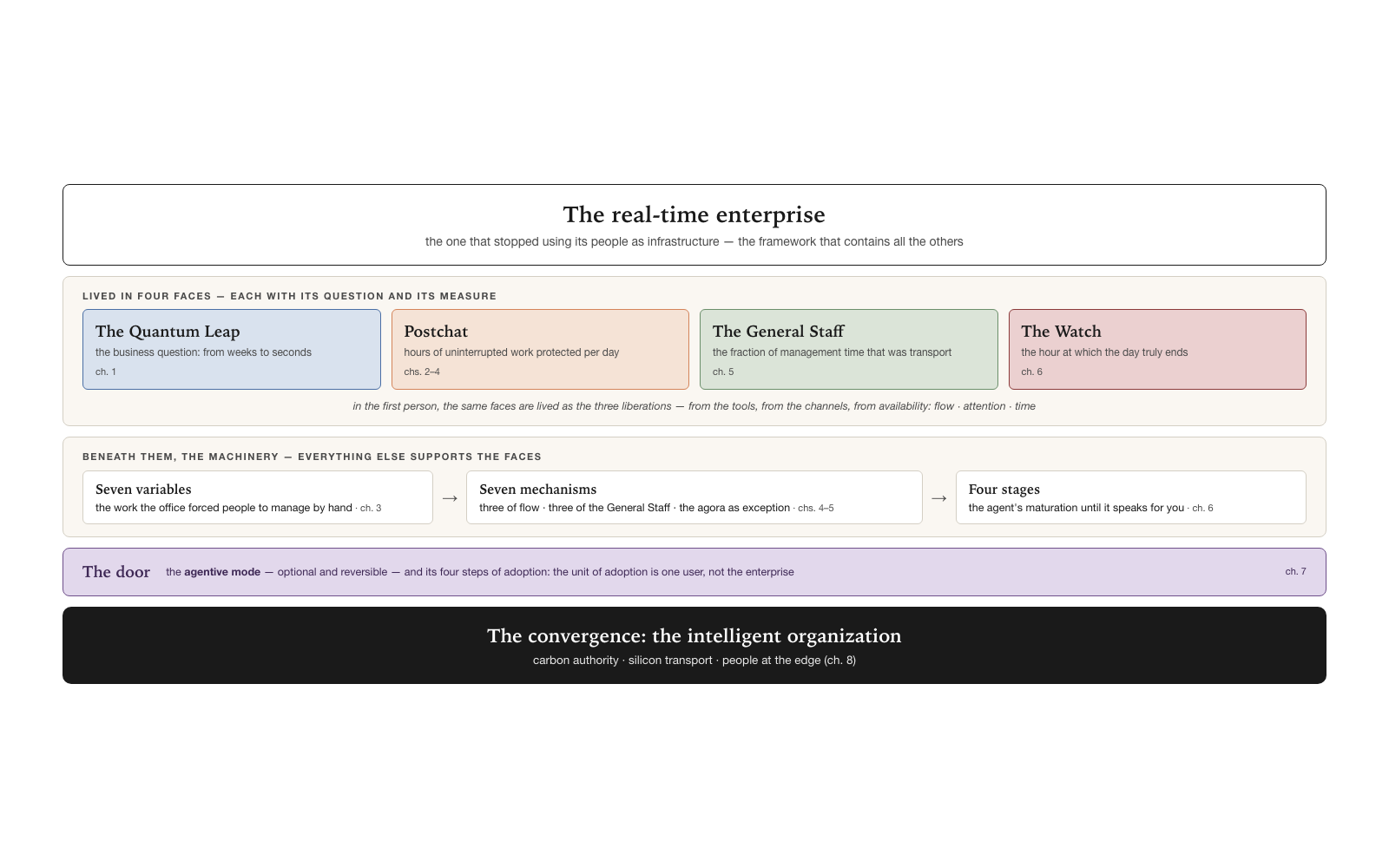
The book’s argument now fits into its complete framework. The real-time enterprise is the one that stopped using people as infrastructure, and that dissolution is lived in four faces:
| Face | Dissolves the person as… | Its measure | Chapters |
|---|---|---|---|
| The Quantum Leap | wire between the data and the decision | from weeks to seconds | 1 |
| Postchat | wire for messages | hours of uninterrupted work protected per person per day | 2–4 |
| The General Staff | wire for management | the fraction of management time that was transport | 5 |
| The Watch | perpetual guard | the hour at which the day truly ends | 6 |
In the first person, that same world is lived as the three liberations the film’s Epilogue named — from the tools, from the channels, from availability; flow, attention, time — and the sequence is not arbitrary: the first installs the agent as the work interface, the second gives it the complete communications context, the third capitalizes that context as the capacity for representation. That is why the order is not skipped — and why the organization that postpones one liberation postpones the ones that follow.
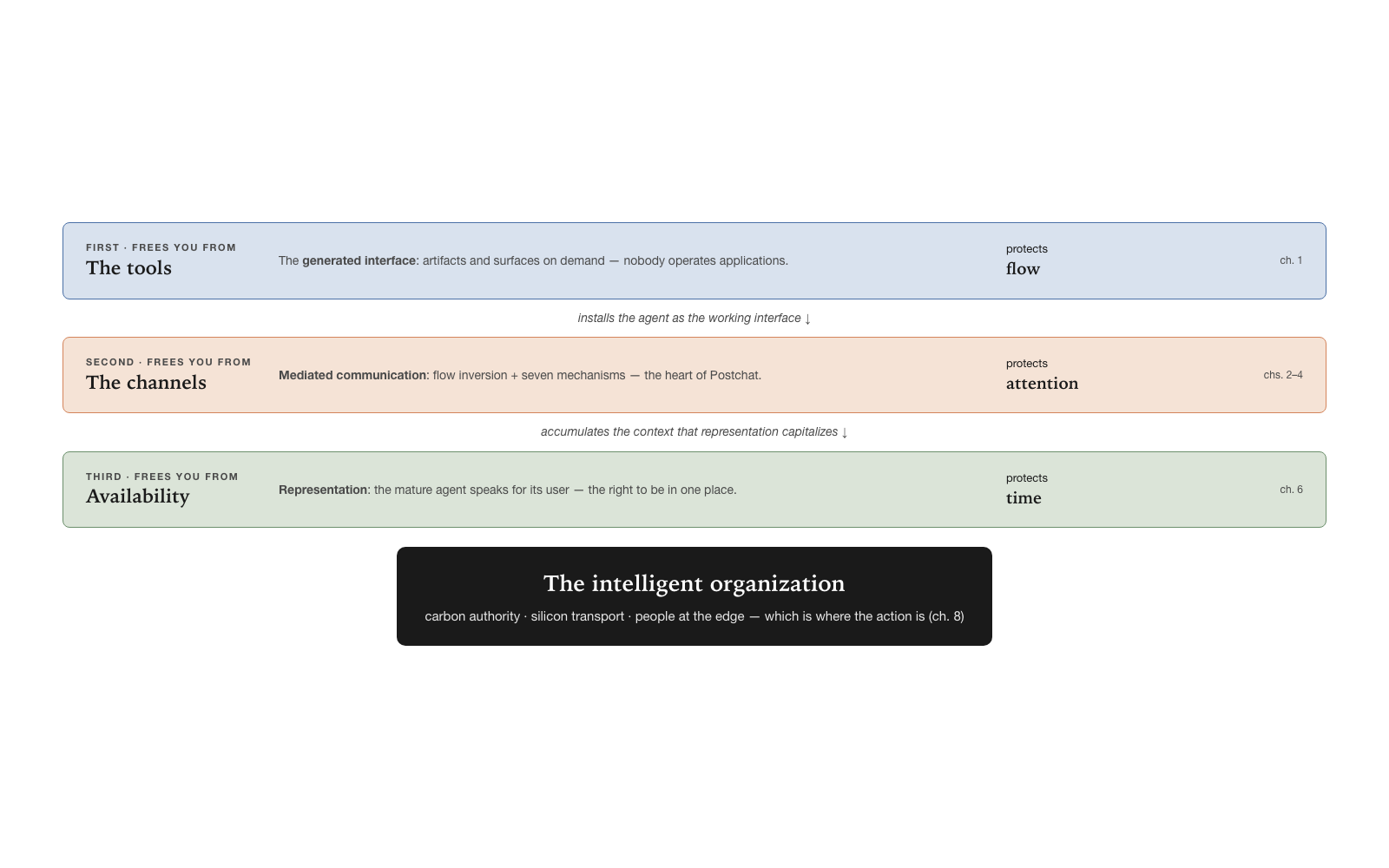
The aggregate consequence (chapter 8) is the change in the organization’s nature: from the pyramid-network that consumed people as transmission infrastructure, to the intelligent organization — carbon authority, silicon transport, people at the edge. It is not a fifth face: it is what the enterprise becomes when the four operate together.
And so that no framework competes with another in your memory, the complete map on one sheet — what is thesis, what is face, and what is merely the machinery that serves them:
The executive agenda
For the leadership team that takes this destination seriously, the agenda has an order:
- Adopt the measures. Each face has its own, and all four can start being measured on Monday — even by hand, even by survey: how long a business question takes to become an answer; how many hours of uninterrupted work each person’s day protects; what fraction of management time is transport; what time the workday truly ends. Your organization’s current numbers will be uncomfortable; that is the point. What gets measured becomes enforceable.
- Classify your infrastructure. For every communication system you operate: is it an interruption factory or an absorber? If your AI plan consists of putting copilots inside the factories, you are optimizing the wrong species.
- Audit the mechanical intermediation. What fraction of your organization’s time is information transport — status meetings, relay reports, chasing acknowledgments? That fraction is your prize size, and it is the face of the General Staff waiting its turn.
- Deploy by mode, not by mandate. The unit of adoption is the voluntary user. Cultivate the desperate, measure mode retention, and let reality make the argument.
- Diagnose your maturity and your terrain. The four faces presuppose capabilities — governed data, known processes, instrumented trust — that are built, not declared. To measure where your organization stands and what it lacks, this trilogy has an entire book: AURA, with its two maturity models (IRIS and MOTOR) and its instruments. For the architecture that makes everything described here operable and governable, the third: AgencyDomains.
The close
And a dividend no metric fully captures: the end of the day exists again. The channel’s workday never ended — the thread was still alive at eleven at night and disconnecting was a transgression you announced with guilt. In this world the workday ends because the system stays on watch. That five o’clock close, with what’s pending in the hands of someone who doesn’t tire, is perhaps the most underrated liberation of them all.
The channel paradigm was not a mistake: it was the best answer of its era. But eras are measured by the technology with which they coordinate work — and the era that used people as infrastructure has just ended.
The enterprise operates in real time. Communication comes to you. People are at the edge. The rest is transition — and the transition has a map.