4. The Mechanisms of the Flow
In the film: the 7:00 briefing and the midday agora. Behind each moment, a mechanism was at work. Here are the ones of the flow — and the principle that governs them all.
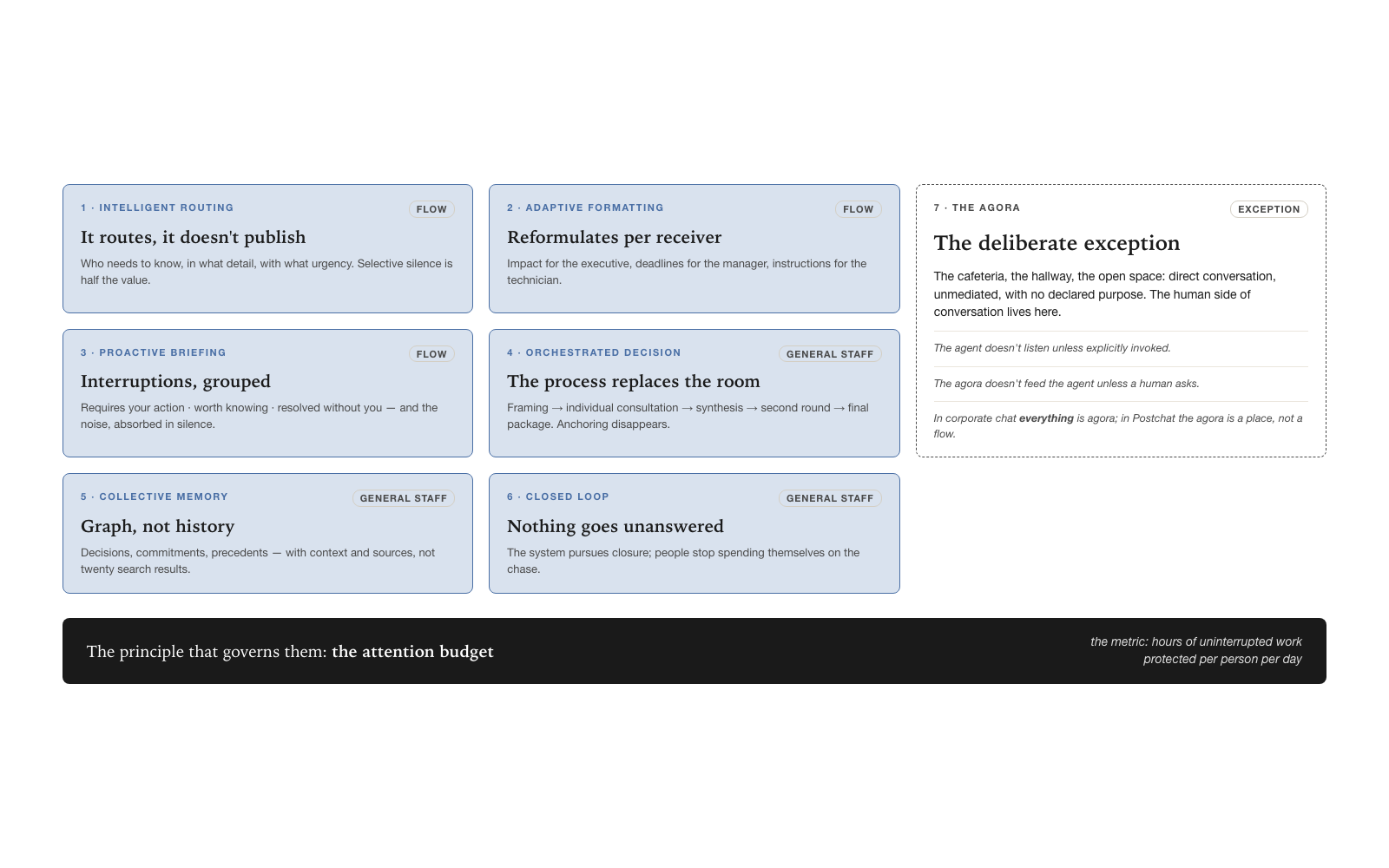
The inversion of the previous chapter is not an aspiration: it is a system of seven mechanisms. (Not to be confused with the seven variables of the previous chapter: those were the work to be managed; these are the machinery that takes it on.) Three are of flow — they move the right communication toward the right person — and this chapter develops them, along with the deliberate exception that completes them. The other three do not transport: they coordinate, remember, and pursue — they are the machinery of the General Staff, and they have the next chapter to themselves.
Intelligent routing
The agent maintains an organizational model: who is who, what matters to whom, who depends on whom, what escalates to what level. When a user communicates something, the agent does not publish it — it routes it: it determines who needs to know, at what level of detail, and with what urgency. Whoever doesn’t need to know never sees it; that selective silence is half the system’s value.
Adaptive formatting
The same content is presented differently depending on the recipient: an impact summary for the executive (three lines, action required or not), data and deadlines for the operations manager, a precise instruction for the technician, a table for the analyst. The agent does not translate: it reformulates for the recipient’s mental model. The cost of communicating well — tailoring the message to each audience — always made doing it by hand unviable; now the machine pays it.
Proactive briefing
The briefing is the piece that turns attention protection into architecture: interruptions batched into predictable moments. The agent absorbs all incoming communication and holds it until the next delivery point — start of day, post-absence, pre-meeting, close — except for genuine urgency, which interrupts immediately because its cost is justified. Between briefings, the blocks of concentration are protected by design. The briefing’s internal structure is always the same triad: requires your action · worth knowing · resolved without you — plus the fourth category that is never shown: the noise, absorbed in silence.
The agora — the deliberate exception
All operational communication passes through the agent. All of it — except one space, and its existence is as much a design choice as the mechanisms before it. The agora — the word comes from the Greek square where the city talked — is the place, physical and digital, of direct conversation without mediation, without structure, and without a declared purpose: the cafeteria, the hallway, the open space where the joke, the celebration, and the half-baked discovery live. In the agora, interruptions are voluntary by definition: nothing operational depends on it, nobody is obliged to watch it, and the agent does not listen to it except by explicit invocation from a human.
The comparison with the previous paradigm is exact: in corporate chat, everything is agora — the urgent query and the lunch photo travel through the same pipe with the same right to interrupt. That is why the channel exhausts: it forces you to inhabit the courtyard all day so as not to miss the one sentence that matters. Postchat does not eliminate the courtyard; it bounds it. And in doing so it answers, in passing, the serendipity objection: the fertile accident — the conversation that sparks an idea — never lived in the channel; it lives in the after-lunch conversation, and people who are not exhausted from processing noise talk more and better.
One design rule completes the picture, and the order of its terms matters: the agora does not feed the agent unless a human asks it to. Free conversation is also free of automatic consequences; if something from the table talk deserves follow-up, it is a person who brings it into the system — never the other way around. It is exactly what Elena did at midday: her question about the simulator was the invocation — the agent searched the digital agora because a human asked; nothing from the table talk had entered any record on its own.
And here it is worth facing the underlying question without anesthesia: does agentive mediation dehumanize work? It depends on which interactions it absorbs. If it absorbed all human interaction, yes — the result would be a silent hive. But the actual inventory of what gets absorbed is different: routing of notices, logistics of consultations, chasing of acknowledgments, classification of routine — transactional interactions, people used as transmission infrastructure. What the agent does not touch — the celebration, the venting, the casual confidence of someone who dares to say that something “feels off” — is the conversation with real human content, which now has more time to exist. With the boundary well drawn, mediation does not dehumanize: it takes the role of cable away from people and gives them back the roles of person.
The principle that governs them: the attention budget
The seven mechanisms — those of this chapter and those of the next — implement a single management policy: treat each person’s attention as a budget that the agent administers. Every incoming communication has a cost (the interruption) and a value (what it enables); the agent spends only when the return justifies it:
| Category | Treatment |
|---|---|
| Genuine urgency (active incident, imminent deadline) | Immediate interruption — the cost is justified |
| Relevant, not urgent | Waits for the next briefing |
| Informational | Travels in the briefing, in a low voice |
| Noise | Absorbed in silence; the user never sees it |
It is the architectural version of Fried’s “library rules”: silence as the default state, interruption as an exception that demands justification — enforced by the system, not by courtesy.
And the policy has its indicator. The office of the channel measures itself with social-network metrics — messages, response times, engagement —, all metrics of activity on the pipe. Postchat measures itself with a single one, and it is a metric of outcome:
Hours of uninterrupted work protected per person per day.
Not how many messages the agent processed: how many hours of concentration it gave back. The metric shifts the burden of proof from the worker to the system — if the protected hours are few, what fails is the infrastructure — and no office of the previous paradigm would dare adopt it, because its result would be a confession.
The essentials
- Three mechanisms move the flow: intelligent routing, adaptive formatting, and proactive briefing. Selective silence is half the value.
- The fourth is a design exception: the agora — direct, voluntary, unlistened human conversation. In chat everything is agora; in Postchat the agora is a place, not a flow.
- The remaining three mechanisms — orchestrated decision, collective memory, closed loop — belong to the General Staff: next chapter.
- Everything is governed by the attention budget, with its metric: hours of uninterrupted work protected per person per day.