6. The Watch
In the film: 3:00 p.m. Andrés was at a substation with no signal, exactly where he was supposed to be, and his agent answered for him — with his conditions, and with a limit: “it’s a commitment he made, and he wouldn’t delegate his word.” This chapter explains what maturity makes that scene possible, and who answers for it. It is the fourth face: the agent that stands watch — and speaks for you — so that you can be in just one place at a time.
Two interfaces of the same agent
The industry conversation about “digital twins” of people usually imagines two systems: the personal assistant that serves you, and the twin that represents you — the second as a future project, separate, to be built “when the technology matures.” The thesis of this chapter is that this picture is wrong in its essentials: they are the same actor with two interfaces.
The internal interface faces the user: it mediates between them and the systems, manages their attention, executes their intentions — everything described in chapters 2 through 5. The external interface faces everyone else: it answers queries on the user’s behalf, upholds their criteria, decides what they delegated.
There are not two builds; there is one maturation. An agent that has spent months mediating its user’s communication — observing how they prioritize, what conditions they set, what they delegate and what they never would — is already a representative in embryonic form. The design question is not “do we build the twin?” but “when does it know enough to speak for you?”. And the transition is not a project: it is an enablement — the same agent, the same accumulated context, a new interface exposed.
The managerial consequence of this thesis is immediate: representation isn’t bought, it’s cultivated. Every month of operation in agentive mode trains the future capacity for representation. The organization that postpones the second liberation postpones, without knowing it, the third.
The maturity spectrum
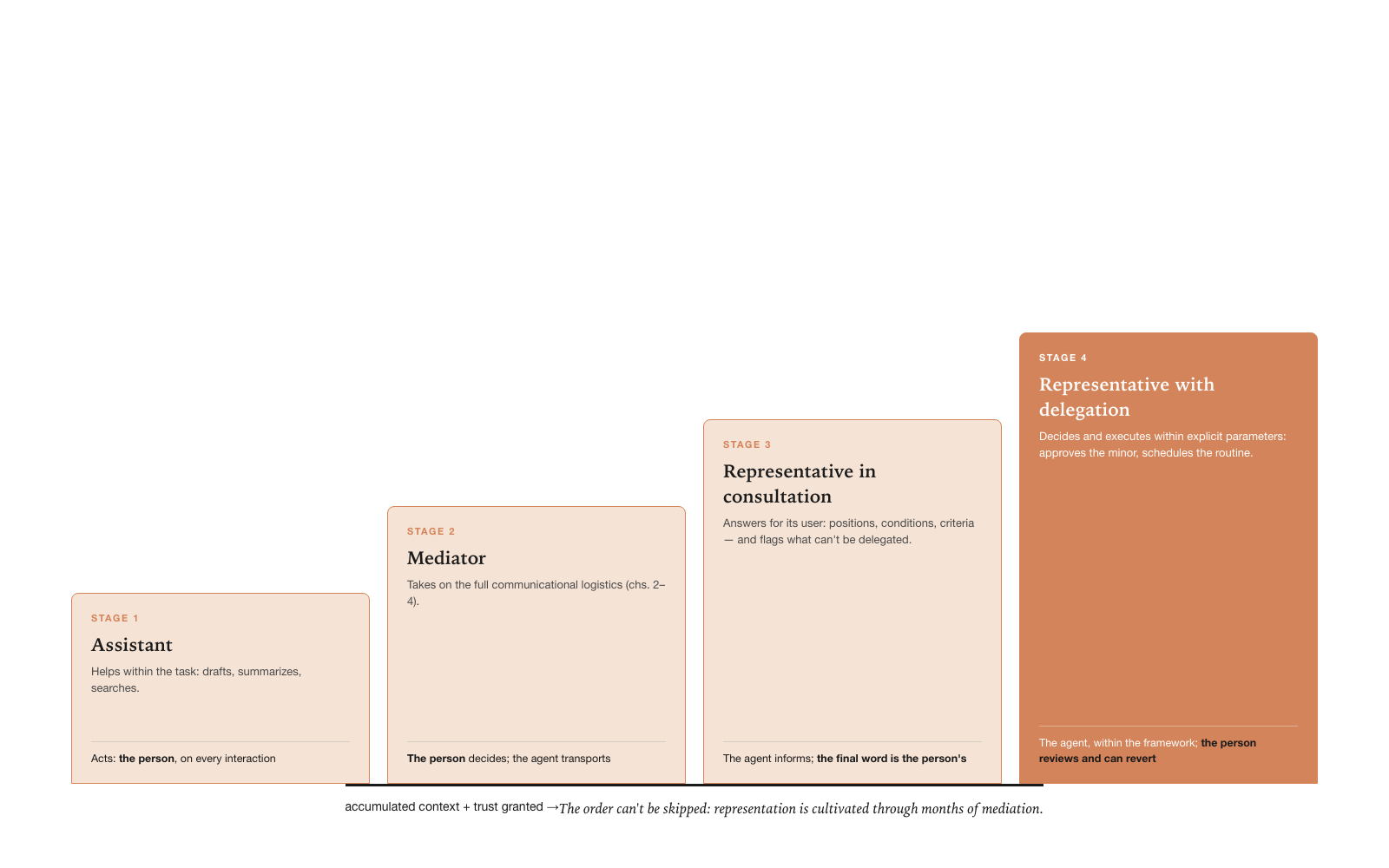
No agent is born representing. The capability progresses along a spectrum of four stages, and what separates each one from the next is not technology — it is accumulated context and granted trust:
| Stage | What does the agent do? | Who acts? |
|---|---|---|
| Assistant | Helps inside the task: drafts, summarizes, searches | The person, in every interaction |
| Mediator | Takes on the full communications and coordination logistics (chapters 2–5) | The person decides; the agent transports |
| Representative in consultation | Answers for its user before others: reports positions, verifies conditions, anticipates criteria | The agent informs; the final word belongs to the person |
| Representative with delegation | Decides and executes within explicit parameters: approves the minor, schedules the routine, answers the frequent | The agent, within the framework; the person reviews and can reverse |
The order is non-negotiable: nobody delegates their signature to an agent that hasn’t demonstrated, over months of mediation, that it understands how its user thinks.
The 15:00 scene pins down the third stage with no need for theory: Andrés’s agent answered with the verified slack and the conditions its user would set — and flagged one as non-delegable, because it involved Andrés’s given word, offering to leave the change pre-approved for his ratification. That sentence — this is not mine to decide — is the mark of the mature representative: it knows, above all, what is not its place.
The uncomfortable questions
Can an agent faithfully represent a person? Not perfectly — and the question is badly calibrated. A human executive assistant doesn’t represent their boss perfectly either, and organizations ran on that imperfection for a century. The usefulness of representation doesn’t demand perfection: it demands getting the delegated right and escalating what exceeds it. The correct design doesn’t pursue one hundred percent fidelity but one hundred percent honesty about the limits.
Who answers when the agent gets it wrong? The one who delegated — exactly as when you delegate to a subordinate. If the agent approves a minor expense within the defined policy and it turns out to be a mistake, the responsibility belongs to whoever defined the policy. The hard case is the remainder: the agent that acts outside its parameters, through failure or interpretation. There, responsibility becomes diffuse, and that is why delegation demands a prior framework: explicit limits, complete traceability of every action taken in someone’s name, and the default rule that ambiguity escalates. Delegation without a framework isn’t maturity — it’s negligence with a friendly interface. The instrumentation of that framework — scoped permissions, protected sensitive data, an auditable record of every action taken in someone’s name — is the trust infrastructure that AgencyDomains specifies; here it is enough to know that it exists, and that without it there is no serious delegation.
What does my agent know about me — and who decides the perimeter? Representation feeds on accumulated context, and that makes urgent a boundary the previous paradigm never needed to name: privacy from your own agent. The rule of this world is that the perimeter is decided by the person, not the system, and it is declared in the moment: whatever is marked off the record does not enter the model the agent has of you — verifiably — and therefore does not enter what your representative knows, says, or uses in your name either. The shoe scene is the domestic case of a serious principle: a faithful representative is not the one that knows everything about you — it is the one that knows exactly what you decided it should know.
And wasn’t availability a virtue? The office of the channel confuses availability with commitment: whoever answers at eleven at night is “all in.” This face proposes the inverse measure of organizational health: that people can be in one place at a time — in the field, in the important decision, at home — without the organization stopping or making them pay for it. Representation doesn’t replace people: it gives them back the right not to be ubiquitous. And the measure of the face is domestic and exact: the hour at which your day truly ends. In the film it was 5:00 p.m. — what was pending stayed in the hands of someone who doesn’t tire, because the one now standing watch is the system.
With the Watch, the picture of the four faces is complete. What remains is what makes them reachable — the door through which a real organization enters this world — and that is the next chapter.
The essentials
- Assistant and “twin” are not two systems: they are two interfaces of one agent that matures.
- The spectrum has four stages — assistant, mediator, representative in consultation, representative with delegation — and the order is not skipped.
- Representation is cultivated through months of mediation; postponing the second liberation postpones the third.
- Delegation demands a framework: explicit limits, traceability, escalation when in doubt. Responsibility belongs to the one who delegates.
- The perimeter of what the agent knows about you is yours to decide, and it is declared: what’s “off the record” enters neither your model nor your representation.